Still Contained?
In February 2007 my co-founder Mark Mahaffey and I were setting up Hinde Capital. Its founding premise was a bet on the outcome of a credit crisis, and we spent those months watching nervously for the first signals. When HSBC warned that bad debts at Household International, its American subprime lender, would run well ahead of expectations, I knew the game was on.1 The regulatory approval could not come fast enough, and I remember agonising over whether we would be up and running in time to place our bets.
It was a warning, not a crisis. The crisis arrived in stages over the following year and a half, through the failure of a specialist lender, the gating of hedge funds, banks left holding loans they could not sell, and finally the freezing of funding markets. Each stage looked contained while it was happening.
That sequence is the most useful yardstick for the AI credit complex today. Stress is plainly present, so the useful question is which stage it has reached. Part I mapped the network and Part II followed the first station on it to light up. This part asks where the system stands on that clock.
As of 25 September the answer is discrimination, not closure. The stress has spread beyond one loan into a pattern. Banks are stuck with project debt they cannot sell, repeat issuers are pre-marketing deals to avoid a poor reception, new-issue AAA data-centre commercial mortgage-backed securities (CMBS) are being marketed wider, and Blue Owl's semi-liquid vehicles are meeting redemptions with promissory notes. Yet the strongest credits still clear easily. Lambda's Baa2 term loan and CoreWeave's $3.7 billion convertible both found ready buyers.
On the 2007 clock, this looks like June.
From One Loan to a Pattern
Jupiter's $18 billion of loans are still quoted at 89 to 91 cents in the reporting, and no confirmed newer price has appeared since Oracle's force majeure notice.2 Bloomberg describes the debt only as trading at stressed levels below 90.3 Talk of a move into the low 80s should be treated as unverified until the Financial Times (FT), Bloomberg or LevFin Insights prints it.
No second AI data-centre project loan has been reported below par. The two closest analogues both run through Blue Owl. Earlier this year it struggled to syndicate the financing for a $4 billion CoreWeave-anchored project in Lancaster, Pennsylvania.4 One specialty lender who passed on the deal said, in effect, that they had seen it and passed, while Blue Owl says the project is fully funded.5 A slow syndication is the step before a sub-par secondary quote, because banks hold the paper and then mark it down to clear it. Lancaster is the single most important item to track.
The second is Digital Drive in Richmond, Virginia, a $1.1 billion high-yield bond from a Blue Owl-affiliated sponsor alongside Cedarwood and PowerHouse Data Centers. Its five-year notes priced at 98.5 cents to yield 9.25 per cent, roughly 270 basis points above similarly rated debt. The 76 megawatt campus is fully leased to CoreWeave on a 15-year, $2.94 billion contract, and S&P rated the notes BB-, warning that exposure to a single speculative-grade tenant is the key risk.6
The market is no longer pricing AI infrastructure as a category. It is pricing the tenant. Projects leased to hyperscalers still clear. QTS sold $3.9 billion of Microsoft-linked Georgia project bonds, investment-grade rated though at a 7.23 per cent yield,7 and Hut 8's $4.25 billion Beacon Point bond priced at Treasuries plus 165 in June.8 Oracle- and CoreWeave-linked projects meet stalled distribution or punitive pricing instead. The systemic threshold is a sub-par quote on a project leased to Microsoft, Meta, Amazon or Google. That has not happened.
The Counterparty, Not the Chip
Part I set out two readings of CoreWeave's widening, the value of its collateral and the quality of its customers. The evidence since points to the customers.
Lambda's $926 million senior secured term loan B priced on 12 August and closed on 27 August at the Secured Overnight Financing Rate (SOFR) plus 300 basis points, issued at 99.5 after tightening 75 basis points in syndication, rated Baa2 by Moody's and fully amortising to the end of 2030.9 It funds graphics processing units (GPUs) dedicated to an unnamed investment-grade offtaker through Lambda's first private-cloud GPU asset-backed vehicle. The collateral is the same class of asset CoreWeave pledges, so what separates the two loans is the customer. Lenders will fund GPUs cheaply when an investment-grade name stands behind the contract, which puts most of CoreWeave's move from SOFR plus 225 to plus 550 down to weaker customers and shorter contracts rather than to doubts about the hardware.10 The widening is partly structural. It still means the marginal CoreWeave dollar costs more.
Equity-linked money remains wide open. CoreWeave priced an upsized $3.7 billion convertible at 2.875 per cent due 2033, settling on 22 September, with a conversion price of about $97.85 against a share price of $79.88 on 17 September.11 It also launched an at-the-market programme for up to 35 million shares, then worth about $2.9 billion, and the stock fell about 4 per cent.12 Backlog stands at $104.2 billion, with more than $25 billion of new commitments early in the third quarter and about 4.2 gigawatts of contracted power.13 Nebius priced an upsized $5 billion convertible on 19 August.14 None of this looks like closure. It does show the funding mix tilting from debt towards dilution.
Blue Owl, the Interchange
The most 2007-like signal in the complex sits in Blue Owl's business development companies (BDCs), the funds through which private credit lends to mid-sized companies, rather than in bond spreads. Blue Owl Technology Income Corp saw second-quarter tenders equal to 38.1 per cent of its shares, accepted only 13.1 per cent of the shares tendered, about $140 million, and paid in non-interest-bearing promissory notes.15 Net asset value was $9.70 a share, and a secondary source puts first-quarter requests at about 40.4 per cent.
The other vehicles show the same strain at lower intensity. Blue Owl Credit Income Corp received second-quarter repurchase requests for 18.8 per cent of its shares, $3.6 billion, down from 21.9 per cent in the first quarter, filled pro rata at the 5 per cent cap, with $11.6 billion of liquidity, a Class I net asset value of $9.14 at 31 August and $478.3 million of unrealised depreciation in the first half. Blue Owl Capital Corp's net asset value fell to $14.26 from $14.81 at the end of 2025, largely on markdowns in a small number of names, with non-accruals rising to 2.8 per cent at cost from 2.0 per cent. Blue Owl Technology Finance Corp's net asset value fell to $16.48 from $17.33, with non-accruals at 0.6 per cent from 0.3 per cent.16
Blue Owl's own shares closed 3.6 per cent lower at about $9.25 on the day of the force majeure notice, on roughly twice their average volume, and are down about 46 per cent over the year.17 It is at once Jupiter's equity sponsor with about $3 billion reported, a CoreWeave project sponsor, and the manager of gated funds.4 That makes it the single most important node to watch for contagion.
None of the BDC filings, however, isolate data-centre, Stack or Jupiter loans. Blue Owl's Jupiter equity appears to sit in its real assets and digital infrastructure platform, and the fund stress so far is generic software and technology lending stress rather than demonstrated data-centre losses. The link to Jupiter runs through reputation and funding, the same manager acting as sponsor, developer and gatekeeper. Blue Owl is reportedly exploring a $6.5 billion data-centre real estate investment trust (REIT) or listing,18 a possible release valve whose reception will be telling. No third-quarter disclosure from Apollo, Ares, Blackstone, KKR, HPS, Cliffwater or Monroe ties markdowns to data-centre loans. Third-quarter BDC results in early to mid November are the next window.
The Bond Market Splits
Reuters reported on 22 September that investment-grade credit has split in two, with AI-related issuers trading persistently wider, at around 115 basis points against 78 for the broad investment-grade market, and hyperscaler gross issuance forecast at a record $420 billion next year. Alphabet reportedly had to offer a large concession in August, in the same period that Aon's $13.5 billion deal drew $65 billion of orders and tightened 35 basis points. Portfolio managers say plainly that default is not their concern. Their concern is concentration and supply.19
JPMorgan's research points the same way in more detail, though it reaches us through a secondary summary.20 Its high-grade measure of high-performance computing (HPC) credit, an internal research series rather than a listed index, widened 38 basis points to 208 between early June and 31 July, and the high-yield measure widened 153 basis points in a month to 418. High-grade project bonds trade 99 basis points wider than the hyperscalers behind them, against 105 in May, and high-yield project bonds 208 wider, against 183. New issues priced at more than twice the J.P. Morgan US Liquid Index (JULI) spread widened 10 basis points after one month and 21 after three, where comparable issues from 2022 to 2025 tightened by 22 to 26. JPMorgan reads this as rational repricing rather than exhausted capacity, and estimates the hyperscalers could issue about $1.7 trillion more in dollar high grade before reaching a 3 per cent index weight. Oracle remains the outlier inside the AI bucket.
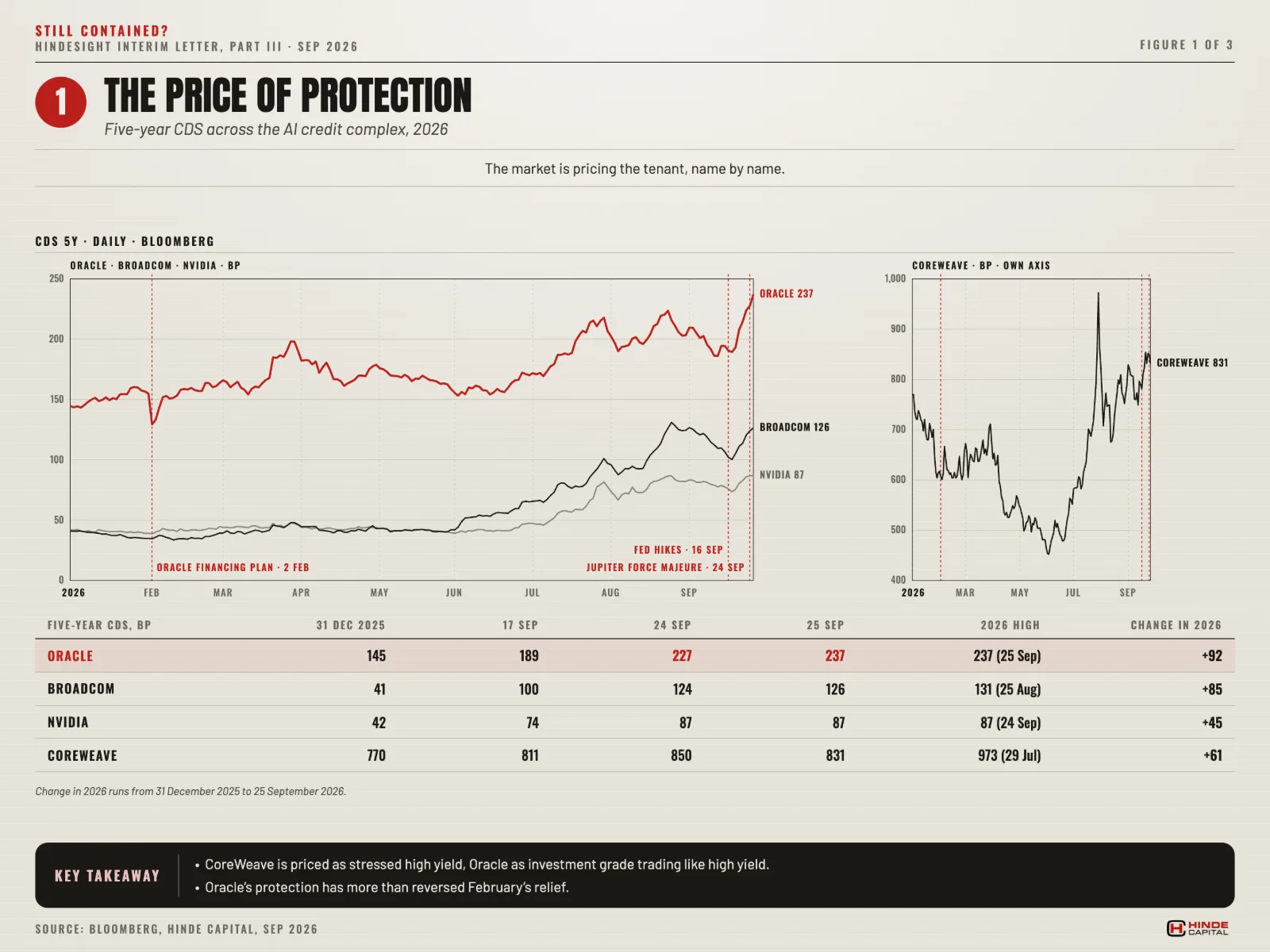
Credit default swaps (CDS) show the same split name by name. On 24 September five-year protection on CoreWeave stood at about 850 basis points, against about 227 for Oracle, 124 for Broadcom and 87 for Nvidia. The order matches the tiering described above. CoreWeave is priced as stressed high yield and Oracle as an investment-grade credit trading like high yield. Broadcom and Nvidia remain investment-grade names, but the cost of protecting against them has moved with their AI financing links, roughly tripling for Broadcom and doubling for Nvidia since the start of the year, with Nvidia's at its highest since the contract began trading.21
Oracle, One Notch Above the Line
S&P cut Oracle to BBB- on 9 July with a stable outlook, calling OpenAI a central credit risk and projecting leverage in the mid-four times range in fiscal 2027.22 No rating agency has acted since. The last confirmed baseline, from February's term sheet, was Moody's at Baa2 on negative outlook and Fitch at BBB stable. A Moody's cut to Baa3 or a negative outlook from S&P would be the next escalation. With S&P already one notch above high yield, any further step there is a fallen-angel event, forcing investment-grade-only mandates to sell Oracle paper and Oracle-linked project debt alike.
Five-year Oracle CDS protection reached about 227 basis points on 24 September, the day of the force majeure report, up from about 189 a week earlier and 145 at the start of the year, and rose to about 237 the next day, its highest level in at least two years.21 That more than reverses the relief of February, when the $45 to $50 billion financing plan cut the cost of protection by 17 per cent.23 A move through 250 to 300 basis points would be consistent with fallen-angel pricing.
The balance sheet explains the market's caution. Oracle reports $664 billion of remaining performance obligations as of 31 August 2026,24 against negative free cash flow of about $23.7 billion for the fiscal year ended 31 May.25 The Wall Street Journal has reported a roughly $300 billion computing contract with OpenAI, which Oracle has not confirmed in its filings.26 It has assembled about $72 billion of partner data-centre debt across Michigan, Texas, Wisconsin and New Mexico, and the $16.3 billion Michigan package reportedly needed PIMCO to anchor about $10 billion of a roughly $14 billion bond tranche after US banks retreated.27 Earlier in the year JPMorgan's syndication of the $38 billion Vantage Stargate loans across Texas and Wisconsin reportedly met thinning demand at the tail, with S&P's Dhaval Shah noting that some banks could be approaching the exposure they are comfortable holding.28
The next hard catalyst is local. A decision on the air-quality permit for Jupiter's Bloom Energy fuel cells is due from the New Mexico environment department by 23 November. Secondary sources report that the state Supreme Court has lifted stays on the application and on construction water pumping, though no primary court record confirms it.29 A denial would turn a delay into a possible stranding of the site's power solution.
The Exit for Construction Loans
Securitisation is the channel that matters most for the Minsky thesis, and it has drawn the least attention. Construction loans like Jupiter's are meant to be refinanced into asset-backed securities (ABS) and CMBS once an asset is built and stabilised. The take-out is the construction lender's exit.
Through July that market held up well. AAA data-centre CMBS had widened only 5 to 10 basis points, a resilience JPMorgan attributed to tenant diversity across enterprise and colocation.20 It is now being tested at the new-issue level. AAA data-centre CMBS was reported trading at 1.65 percentage points over floating benchmarks, wider than office, retail and industrial,30 and GlobalCapital reported Pevco marketing a $301 million data-centre CMBS at 225 basis points for its triple-As, about 60 basis points wide of that secondary level, though this may be specific to one small deal.31
QTS, Blackstone's bellwether, has had a telling year. A March ABS priced at the wide end, 195 basis points, after investors refused 10-year bonds. An April $4.6 billion corporate bond priced at 137.5 basis points and later widened to about 170. A $1.26 billion 10-year CMBS met difficulty in June. In September a $280 million BBB- tranche of a $1.47 billion stabilised ABS needed an unusual two-week pre-marketing period, which GlobalCapital read as recognition that QTS might have had a rough reception going straight to syndication.32 Outstanding data-centre ABS and CMBS totals about $61 billion,33 and operators are reportedly weighing alternatives as securitisation stretches.31
Securitisation is not broken. It is showing limits on tenor and size, and that matters out of proportion to its size. If the take-out narrows, every construction lender's exit risk rises. That is Minsky's refinancing channel in its most direct form.
SB Energy and the Equity Cushion
SB Energy has filed an amended S-1 registration statement, featuring Nvidia's total $3 billion stake more prominently on the cover after feedback from the Securities and Exchange Commission, but it has not priced and has not withdrawn.34 The New York Times, citing four sources, reports the listing will not happen before mid to late October amid pushback on a valuation above $50 billion. SB Energy's first-half revenue was $139 million against a net loss of $3.21 billion, and it projects a $439 billion backlog over about 20 years, starting in 2028.35 A source told Investing.com the initial public offering (IPO) is proceeding as planned,36 which is easier to say when no date was ever set. Reuters reports that the Jupiter notice is already weighing on SB Energy's Ohio deal.4 No change to Nvidia's conditional guarantee on the Ohio campus has been reported.
The Regulators Are Quiet
No new publication from the Federal Reserve, the International Monetary Fund (IMF), the Bank for International Settlements or the European Central Bank specifically on AI-infrastructure financing has appeared since the Bank of England's July Financial Stability Report. The existing reference points are thin. The Chicago Fed noted in February that banks' direct AI-adjacent exposure averages 0.8 per cent of assets, while acknowledging that banks likely carry more through lending to non-bank financial institutions.37 A spring Fed survey found rising concern about debt-financed AI capital expenditure.38 The New York Fed's John Williams has said he is not especially worried about the financial stability risk from this leverage for now, while the Kansas City Fed's Jeffrey Schmid has asked what happens if a spark lands in an increasingly leveraged circle.39 The IMF's October Global Financial Stability Report is the next likely venue for a fresh assessment.
Moody's has been blunter, warning that unprecedented AI spending threatens the hyperscalers' credit quality and counting $1.2 trillion of lease commitments, $820 billion of them not yet commenced, as debt-like.40
Rates Have Moved Instead
Rates sit above all of this, and since the Federal Reserve raised rates on 16 September for the first time in three years they have moved sharply.41 At the close on 25 September the 2-year Treasury yield stood at about 4.86 per cent, the 5-year at 4.99 per cent, the 10-year at 5.17 per cent and the 30-year at 5.49 per cent, after highs of 5.09, 5.23 and 5.53 per cent on the three longer maturities.42 The 10-year has reached its highest level since 2007 and the 30-year its highest since 2004, and traders now put the chance of another hike in October above 75 per cent.43
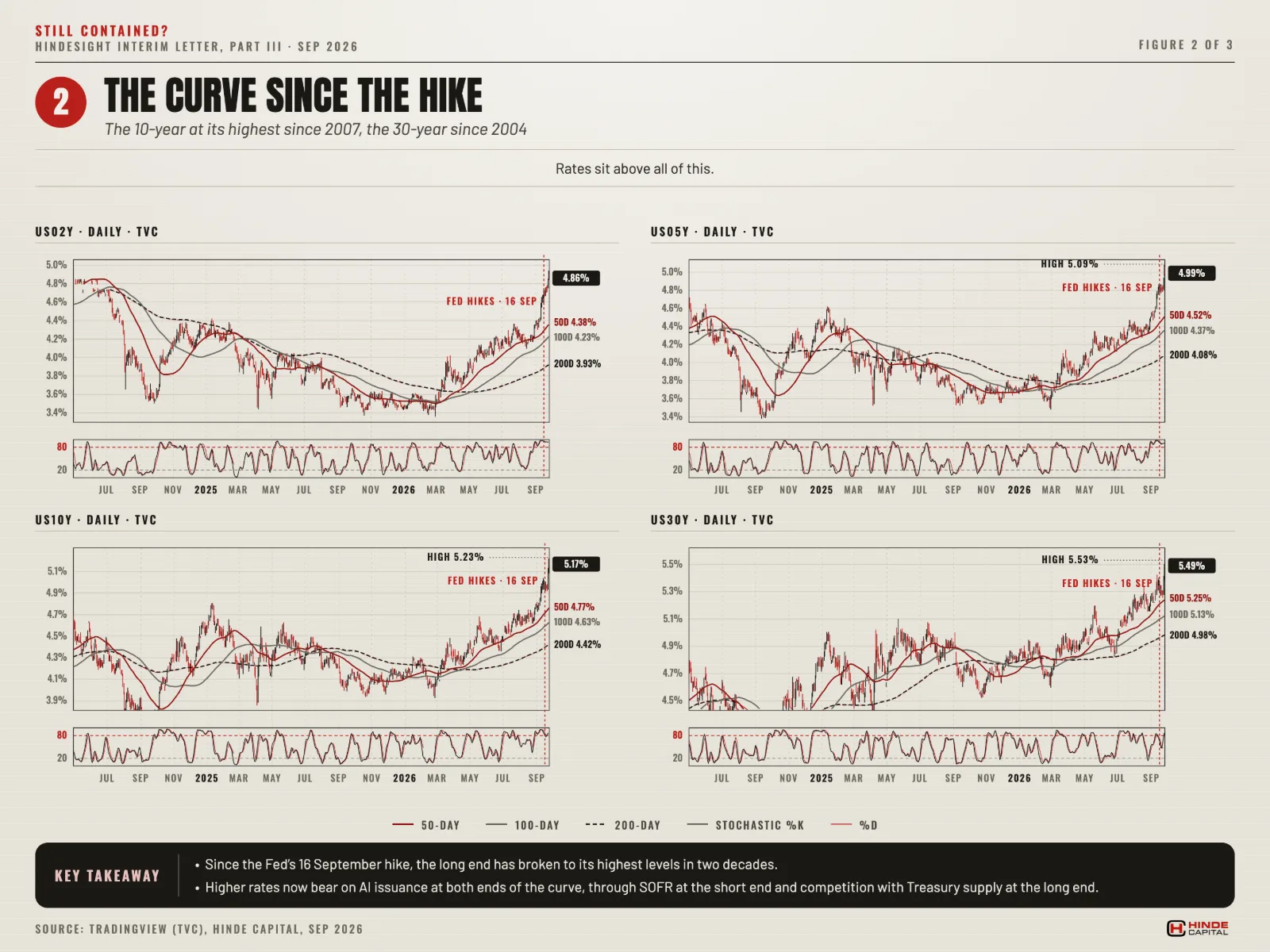
That is a problem for issuance at both ends of the curve. At the short end, SOFR has risen with the policy rate, lifting the floating-rate interest bills described in Part I. At the long end, the hyperscalers are selling long-dated bonds into a market where the US Treasury is itself a heavy borrower, and the two are now competing for the same buyers. Borrowing costs have risen for both. The Minsky trigger described in the August letter's section The Bond Market Sits Underneath Everything, refinancing costs rising just as the take-out market narrows, is no longer a conditional.
Canaries
No AI-infrastructure default, missed coupon, covenant breach or forced asset sale was reported in September. The softer canaries are accumulating. Holtec has paused its IPO.35 Data Center Watch reported at least 75 projects worth about $130 billion blocked or delayed in the first quarter,44 and a second-quarter update added at least 45 projects worth $68 billion.4 Litigation is growing, including an Oracle bondholder class action filed in January and a securities suit against CoreWeave.45 Reports that Jupiter has been mothballed are unconfirmed and contradicted by both companies, and should be disregarded.46
Texas has paused new data-centre interconnections since the governor called for a moratorium on 3 August, and the Electric Reliability Council of Texas, the state's grid operator, aims to finish auditing hundreds of proposals by 10 December before connections resume.47˒48 Its interconnection queue totals about 474 gigawatts, roughly 90 per cent of it data centres and more than five times the grid's record peak demand, and experts say a substantial share may be speculative or duplicative.48
Collateral is thinning at the grid end too. On 22 September the Federal Energy Regulatory Commission declined to rule on Commonwealth Edison's attempt to cancel a transmission security agreement for PowerHouse Hillwood's 1.8 gigawatt, $20 billion data centre in Joliet, Illinois, leaving the dispute to the courts. The developer contends it met the agreement's initial credit requirement by posting $1. One commissioner called that an embarrassing legal fiction.49 PowerHouse Hillwood is a joint venture of Hillwood and PowerHouse Data Centers, the same developer behind the CoreWeave-leased Digital Drive campus in Richmond.50
Where We Stand Against 2007
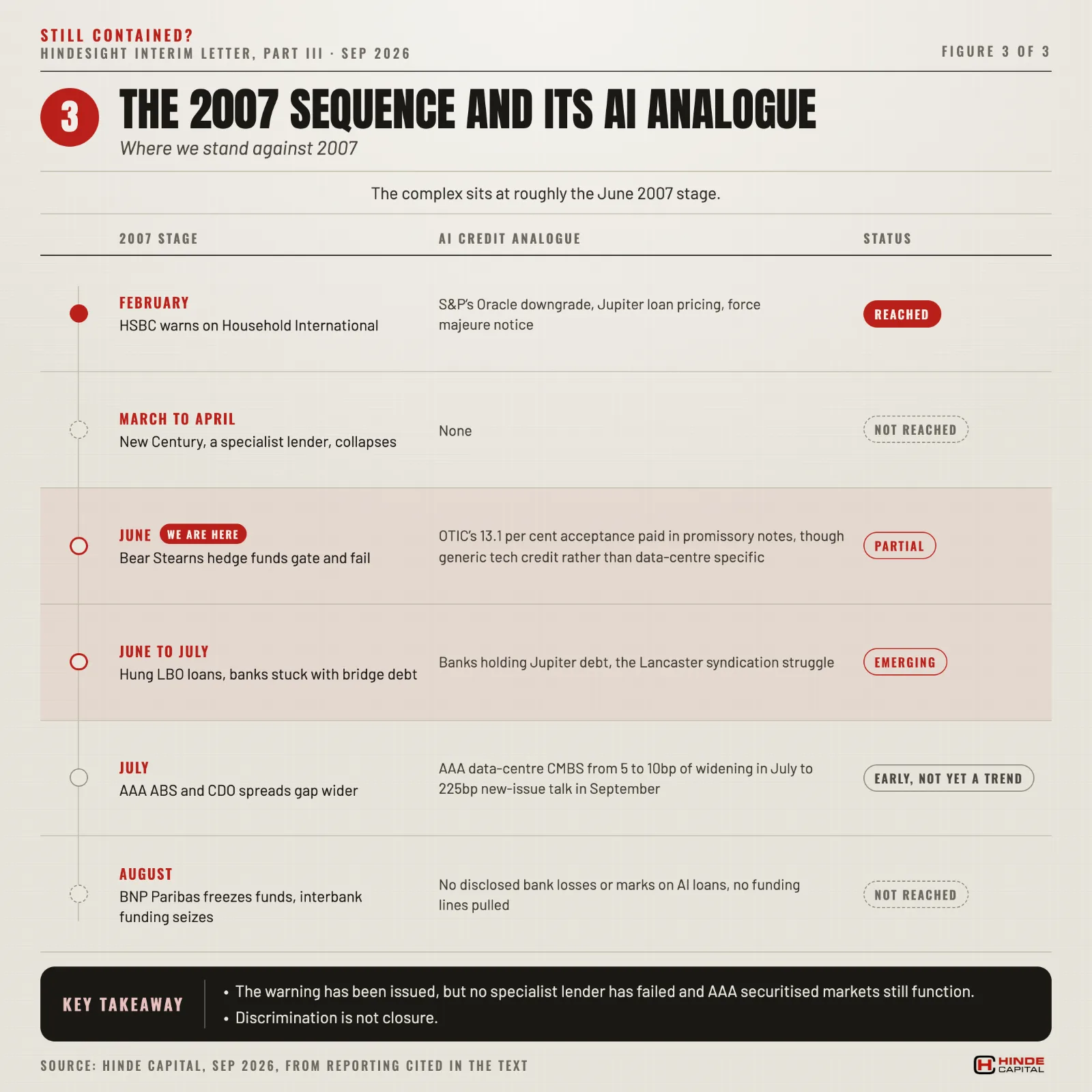
The strongest case against the analogy deserves its full weight. The ultimate obligors in this cycle, Microsoft, Meta, Alphabet and Amazon, are cash-generative credits rated AA. Subprime had no Microsoft at the bottom of the stack. That makes a wholesale closure far less likely than a tiered market, in which Oracle-, OpenAI- and neocloud-linked paper is repriced sharply while the hyperscalers' own credit holds. That is where the evidence currently points, and it is a meaningfully different outcome from 2008. It is not, however, a painless one for the tiers below.
The Rally That Could Still Come
The near-term picture may differ from the trend. Yields have reached sharply overbought levels, the Treasury may yet have tools to cap the long end, and if US equities crack under this credit reflexivity, bonds would be the beneficiary.
Equities may not crack yet. The S&P 500 and Nasdaq 100 have still to fail at these levels and join the transports, utilities, banks, small caps and the Dow Industrials, which have come close to collapse without making new highs. Breadth is poor. Yet three things could still carry the market higher. One is the run into an Anthropic listing, reportedly planned for the weeks before the November midterms.51 Another is the narrative of recursive self-improvement, AI that accelerates its own development. The third is that semiconductor and memory stocks look cheap on price to earnings, despite the August letter's warning that both sides of that ratio may now be reflexive. The period after a midterm election also has a remarkable tendency to be bullish.
2007 offers the precedent. Credit markets froze in August and the S&P 500 made its high in October. A surge in equities while the credit migration is under way would not contradict this thesis. It would repeat the sequence.
In the end the regulatory approval came through in time. Mark and I were able to speculate on that October top, and to benefit from the take-off in gold that followed.
The sequence also carries a warning. Michael Burry has pointed out that markets tend to peak in the middle of a capital cycle rather than at its end. In the last one, investment kept rising through 2009 while the S&P 500 fell from its October 2007 high to an intraday low of 666 in March 2009.52 Continued AI capital expenditure is therefore no evidence that the equity top is still ahead. The market can turn while the spending carries on.
What Would Change the Reading
In the language of Part I, the trigger is a second station lighting up, a second project loan quoted below 95 outside Jupiter, whether on Lancaster, any Vantage or Abilene Stargate tranche, or the Michigan Oracle package. Beyond that, five things are worth watching.
The permit decision. The 23 November air-quality decision in New Mexico could push Jupiter's debt materially lower and prompt Moody's to act on Oracle.
Oracle's rating. Oracle's fallen-angel risk shows up first in S&P's outlook and the five-year CDS.
Blue Owl's tenders. The third-quarter tender results and BDC marks in October and November will show whether acceptance rates fall further, any data-centre loan is marked down, or the $6.5 billion REIT prices.
The exit market. Final pricing on AAA data-centre CMBS and ABS matters because, if 225 basis points becomes the norm, the exit for construction debt is impaired.
SB Energy. A withdrawal or a sharp cut in valuation would signal that the equity cushion beneath OpenAI-linked projects is thinning.
The reading would be wrong if Lancaster clears, Pevco's pricing proves specific to one deal, Blue Owl's acceptance rates recover and the next Stargate financing prices near par. Discrimination would then have been the whole of it, and the 2007 analogy would flatter the risk.
The relative view follows from the tiering. Senior securitised paper and hyperscaler-tenant project debt look preferable to project debt resting on Oracle, OpenAI or neocloud tenants, where the market is already demanding roughly 200 basis points or more for single-tenant speculative-grade exposure.
In March 2007, a few weeks after HSBC's warning, the Federal Reserve judged that the damage from subprime seemed likely to be contained.53 For a while it was. Containment held until the funding markets carrying the risk stopped carrying it.
The AI credit complex has had its warning. Its funding markets are still carrying the risk, at a price, and with growing discrimination about whose risk they carry. Discrimination is not closure. The next three months, from a permit decision in New Mexico to Blue Owl's tender results, will show whether it is the stage before it.
A Note on Sources
Several key sources, among them Bloomberg, the FT and Reuters analyses, were read through syndicated copies rather than the originals, and the Jupiter price of 89 to 91 cents is FT-sourced, relayed by Reuters. The JPMorgan data comes through a secondary summary rather than the note itself, and its conclusions are analyst opinion rather than market fact. The detailed terms of Nvidia's $105 billion guarantee could not be independently confirmed. No rating agency had acted on Oracle since S&P's downgrade of 9 July at the time of writing. The Pevco figure is marketing-stage talk on a small deal. The BDC stress described here has not been shown to arise from data-centre loans.
Sources
- 1HSBC Holdings plc, trading update on US mortgage services loan impairment charges, 7 February 2007.
- 2TIKR, “Oracle's Project Jupiter Loans Are Trading at 90 Cents. Here's What the Q1 Numbers Say,” citing the FT and Reuters, September 2026.
- 3Bloomberg, via Yahoo Finance, “Oracle Cites ‘Force Majeure’ to Shield Itself on Controversial Data Center,” 24 September 2026.
- 4Reuters, via Yahoo Finance, “Analysis-Oracle, Blue Owl project delay sends ripples through AI financing, sources say,” 24 September 2026.
- 5Business Insider, reporting on Blue Owl's Lancaster, Pennsylvania CoreWeave-anchored project syndication, 2026.
- 6Bloomberg, via Briefs Finance, “CoreWeave-Tied Data Center Raises $1.1 Billion in Junk Bonds,” 23 September 2026.
- 7GlobalCapital, reporting on QTS's Microsoft-linked Georgia data-centre project bond, 2026.
- 8Hut 8 Corp., “Hut 8 Closes $4.25 Billion of Investment-Grade Senior Secured Notes for Beacon Point Data Center Project,” 9 June 2026.
- 9Lambda, “Lambda prices and closes $926 million senior secured term loan B facility,” 12 and 27 August 2026.
- 10CoreWeave investor relations and SEC Form 8-K filings, DDTL 4.0 (March 2026), DDTL 5.0 (May 2026), DDTL 5.5 (7 August 2026); Stock Titan secondary coverage.
- 11CoreWeave investor relations, “CoreWeave Prices Upsized $3.7 Billion Convertible Senior Notes Offering,” priced 18 September 2026, settled 22 September 2026.
- 12Money Morning and Trading Pedia, coverage of CoreWeave's at-the-market equity programme, 17 to 18 September 2026.
- 13CoreWeave company disclosures, third-quarter 2026 backlog and contracted power figures.
- 14Nebius, “Nebius Group announces pricing of upsized private offering of $5.0 billion of convertible senior notes,” 19 August 2026.
- 15SEC EDGAR, Blue Owl Technology Income Corp (OTIC), Schedule TO final amendment, 24 July 2026; AltsWire secondary coverage.
- 16SEC EDGAR, Blue Owl Credit Income Corp (OCIC) Form 8-K and 10-Q; Blue Owl Capital Corp (OBDC) Form 8-K; Blue Owl Technology Finance Corp (OTF) Form 8-K; second-quarter 2026 filings.
- 17CNBC market data, Blue Owl Capital Inc. (OWL), 24 to 25 September 2026.
- 18Bloomberg, via TipRanks, reporting on Blue Owl's exploration of a $6.5bn data-centre REIT or IPO, 4 September 2026.
- 19Reuters, via Investing.com and other syndicated copies, “Corporate bond buyers get picky with flood of AI debt,” 22 September 2026.
- 20Macrostream, summary of JPMorgan credit research, “AI Capex Financing: Data Center and Hyperscaler Bond Matrix 2.0,” 31 July 2026.
- 21Bloomberg, five-year credit default swap levels for Oracle, Broadcom, Nvidia and CoreWeave, daily data to 25 September 2026.
- 22MLQ News, “S&P Downgrades Oracle to BBB-, One Notch Above Junk, Citing OpenAI Concentration Risk,” 9 July 2026.
- 23CNBC, “Oracle's credit default swaps are plummeting as financing plan boosts investor confidence,” 2 February 2026.
- 24Oracle Corporation, Form 10-Q for the quarter ended 31 August 2026, filed 11 September 2026, remaining performance obligations.
- 25Oracle Corporation, Form 10-K for the fiscal year ended 31 May 2026, and fiscal fourth-quarter earnings release, 10 June 2026 (operating cash flow of $31,977 million less capital expenditures of $55,663 million).
- 26The Wall Street Journal, report on OpenAI's roughly $300 billion, five-year computing contract with Oracle, September 2025.
- 27The Next Web, “Oracle's $16.3B data centre financing required PIMCO to anchor $10B after US banks retreated,” 2026.
- 28Business Insider, reporting on JPMorgan's syndication of Oracle's $38bn Vantage Stargate loans, via secondary coverage, 2026.
- 29Sift & Signal, “Oracle hit force majeure on its biggest AI site. The loans were already at 89 cents,” September 2026; Santa Fe New Mexican, local reporting on Project Jupiter permitting.
- 30Propmodo, “Data Center Debt Pushes CMBS Investors Into Uncharted Territory,” September 2026.
- 31GlobalCapital, “Data center ABS may not be easy as first thought,” 28 August 2026.
- 32GlobalCapital, “Rapid QTS data center dealmaking both a warning and a sign of success,” and related QTS deal coverage, 2026.
- 33Structured Finance Association, “SFA Research Corner: How Data Center ABS and CMBS Fit in a Broader Financing Ecosystem,” 23 July 2026, Barclays data.
- 34Briefs Finance, “SoftBank-Backed SB Energy Lines Up IPO Roadshow After SEC Feedback,” September 2026.
- 35Wall St Engine and New York Times-sourced reporting, “SoftBank-Backed SB Energy Delays IPO As Investors Push Back On $50B+ Valuation,” 21 September 2026.
- 36Investing.com, “Exclusive: SB Energy Nasdaq IPO moving forward as planned,” September 2026.
- 37Federal Reserve Bank of Chicago, commentary on bank exposure to AI-adjacent lending, February 2026.
- 38PYMNTS, “Fed Survey Finds Increased Worries About AI's Impact on Financial Stability,” 2026.
- 39BigGo Finance, “Fed Officials Begin Assessing Financial Stability Risks From Frenzied AI Investment Boom,” 2026.
- 40CNBC, “Moody's says ‘unprecedented’ AI spending threatens credit quality of Amazon, Meta, Alphabet and others,” 24 July 2026.
- 41CNBC, “10-year Treasury yield climbs back to 5% after Fed hikes rates, Warsh highlights inflation risks,” 16 September 2026.
- 42TradingView (TVC), US02Y, US05Y, US10Y and US30Y, daily closes and highs to 25 September 2026.
- 43CNBC, “30-year Treasury yield hits highest level since 2004 as bond market rout continues,” 24 September 2026.
- 44TechRadar, “$130 billion worth of AI data center projects were cancelled or delayed in Q1 2026,” citing Data Center Watch (10a Labs).
- 45Quinn Emanuel, “Financing the AI Infrastructure Boom: Emerging Litigation Risks in AI Data Centers,” client alert, 13 March 2026.
- 46Crypto Briefing, “Oracle's Project Jupiter in New Mexico reportedly mothballed as $18B loan trades at steep discount,” September 2026, unconfirmed and disputed by Oracle and Blue Owl.
- 47Office of the Governor of Texas, data centres directive letter to the Public Utility Commission of Texas and ERCOT, 3 August 2026.
- 48Robert Walton, Utility Dive, “ERCOT aims to complete Texas governor's data center audit by December,” 21 August 2026.
- 49Ethan Howland, Utility Dive, “FERC rejects ComEd's cancellation of PowerHouse Hillwood data center contract,” 23 September 2026, reporting FERC's order of 22 September 2026.
- 50Joliet Technology Center project site, campus delivered by Hillwood and PowerHouse Data Centers; Ethan Howland, Utility Dive, 23 September 2026, on the PowerHouse Hillwood joint venture.
- 51Reuters, “Anthropic IPO launch shifts toward mid-October, sources say,” 4 September 2026, updated 8 September; Reuters citing The Information, 27 August 2026; Anthropic, confidential submission of a draft Form S-1, 1 June 2026.
- 52Michael Burry, “Capital Cycle IQ & Forensic Files on the Big 5 Hyperscalers,” The Heretic’s Guide to AI’s Stars Part V, Cassandra Unchained, 24 September 2026.
- 53Ben S. Bernanke, “The Economic Outlook,” testimony before the Joint Economic Committee, US Congress, 28 March 2007.
This is not investment advice. It is one person thinking out loud about markets, usually with a position on, so assume I may be talking my own book. That is not a confession, merely useful information. Views can change quickly, occasionally before the ink is dry, and I am not going to defend a trade simply because I once wrote about it with great conviction. Nothing here is an offer, solicitation or recommendation to buy or sell anything.
I write HindeSight primarily for me. The process forces me to test the thesis, join a few dots, throw some away and, with luck, understand the problem rather better than when I started. If it sparks a thought in someone else, even better. There is no publication schedule. I write when I have something to say or when the urge becomes sufficiently annoying that writing it down is easier. I can be tactically bearish and medium-term bullish, long one week and short the next. Markets rarely reward consistency for consistency’s sake. My objective is simpler: find the best risk/reward and try to extract as much upside as possible while giving as little back as possible.
Hinde Capital no longer manages external capital, so there is nothing to sell you. Past performance is no guide to future returns and, frankly, neither is this letter. Do your own work, size risk so you can still sleep, and seek regulated advice where appropriate. No liability is accepted for losses arising from reliance on this material, including those incurred after forwarding it to your sister- or brother-in-law. © Hinde Capital 2026.