
An Act of Jupiter
Force majeure is the legal term for an act of God. In New Mexico, the relevant deity has turned out to be the State Land Office.
On 24 September Bloomberg reported that Oracle had sent a force majeure notice to the Blue Owl unit developing Project Jupiter, the 2.45 gigawatt AI campus Oracle has agreed to anchor in Doña Ana County.1 Six days earlier the Financial Times had reported that the project's $18 billion of loans were being quoted at 89 to 91 cents on the dollar.2˒3 Nobody has defaulted and nobody has missed a payment. Yet this is the first place the migration described in A Credit Cycle Wearing AI's Costume has appeared in a market price rather than in a piece of analysis.
The thesis of that letter was that AI could succeed completely while the financing structure built around it still broke. It traced a Minsky migration from hedge finance towards speculative finance, happening quietly inside take-or-pay contracts, remaining performance obligations (RPO) and hyperscaler leases, well before any single company needed to fail. Jupiter gives that migration a name and a date. Part I of this series drew the map. This part follows the first station on it to light up.
What Happened
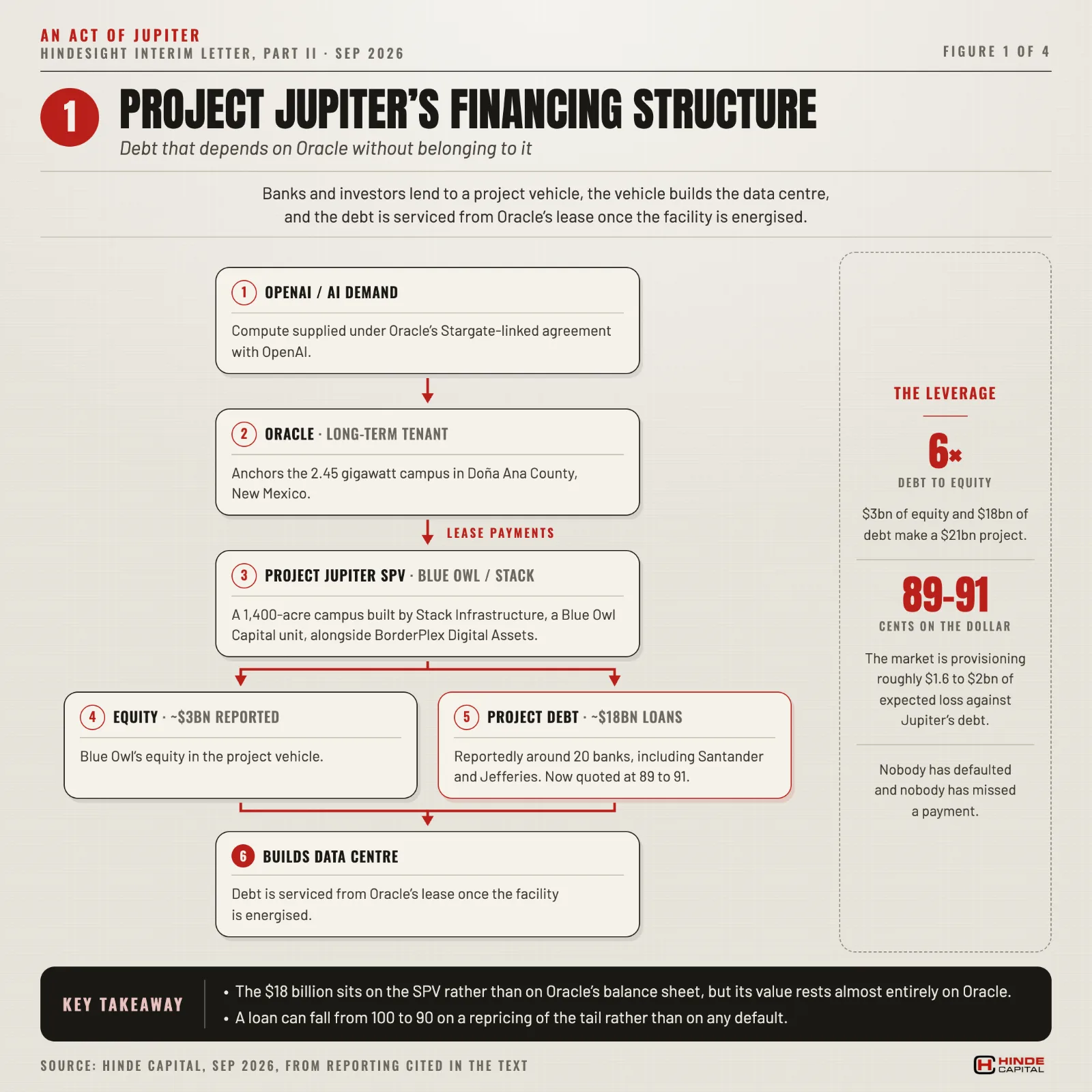
Jupiter is a 1,400-acre campus being built by Stack Infrastructure, a Blue Owl Capital unit, alongside BorderPlex Digital Assets, to supply compute under Oracle's Stargate-linked agreement with OpenAI. Blue Owl holds roughly $3 billion of equity in the special purpose vehicle (SPV) that owns the project.4 The $18 billion of project debt was reportedly arranged through around 20 banks, including Santander and Jefferies, and was meant to be syndicated to institutional investors in the usual way. That distribution has stalled, and the banks are holding more Oracle-linked paper than they intended.5
Oracle's place in the chain deserves a reminder. OpenAI's contract is with Oracle, which leases the campus, runs its cloud service there and sells the capacity on. More importantly, Oracle lends the structure its credit. OpenAI, a private company without an investment-grade rating, could not borrow $18 billion on its own promise. Oracle's lease is what makes the debt financeable, which is why the August letter quoted Stijn Van Nieuwerburgh's observation that OpenAI needs Oracle's credit rating to survive.6 The corollary is that Oracle owes the rent whatever OpenAI does, and S&P has named OpenAI a central risk to Oracle's credit.7
Oracle is not trying to walk away as tenant. The notice is narrower, and more revealing. It allows Oracle to defer rent if the facility is not operating by its 2028 target date. Oracle says Jupiter remains on its planned schedule and that it is fully committed to New Mexico. Blue Owl says the notice does not change its financial commitments to the project.8 Oracle's shares fell between 3 and 7 per cent across the two reports.
The cause is physical. The August letter set out Elon Musk's concern that physical infrastructure would arrive too slowly to meet compute demand, and Jupiter is that concern playing out at a single site. Musk has set his sights on Mars. Jupiter, for now, is stuck in Doña Ana County. Between the demand for compute and usable compute sits a long chain of land, power, grid connection, gas, water, cooling, permits, transformers, graphics processing units (GPUs), construction and financing. Any one link can hold up all the others.
At Jupiter the link was gas. The New Mexico State Land Office has repeatedly refused state trust-land right-of-way permits for Energy Transfer's 17-mile Green Chile pipeline, pushing its in-service date from August 2026 to 1 February 2027. A 2.2 gigawatt gas turbine application has been denied, and an air-quality permit for the site's Bloom Energy fuel cells awaits a state decision due by 23 November.9 A source told Reuters the project as a whole is now expected to slip by about a year.4
Debt That Depends on Oracle Without Belonging to It
None of this is new. The Take-or-Pay, RPO and the Reset Wall section of the August letter described this mechanism in the abstract. Jupiter is the first named case.
Oracle's own bonds are the simple case. Oracle borrows, and investors hold a claim on Oracle. Jupiter is the other kind. Banks and investors lend to a project vehicle, the vehicle builds the data centre, and the debt is serviced from Oracle's lease once the facility is energised. The $18 billion sits on the SPV rather than on Oracle's balance sheet, but its value rests almost entirely on Oracle. That is the distinction the August letter drew between debt a hyperscaler owes and debt that depends on a hyperscaler without appearing in its accounts. Jupiter is a clean example of the second.
The leverage explains how the price can move this far with nothing having gone wrong. Three billion dollars of equity and $18 billion of debt make a $21 billion project, roughly six times debt to equity. Suppose the finished asset were revalued to $15 billion, whether through delay, through Nvidia's next hardware generation eroding the residual value of what is installed, or simply through investors questioning utilisation. The equity is gone and the lenders are impaired, and Oracle has not missed a payment. A loan can therefore fall from 100 to 90 on a repricing of the tail rather than on any default. At 89 to 91 cents, the market is provisioning roughly $1.6 to $2 billion of expected loss against Jupiter's debt.
The force majeure notice is the more important of the two signals, because it changes the model investors were using to hold the loan.
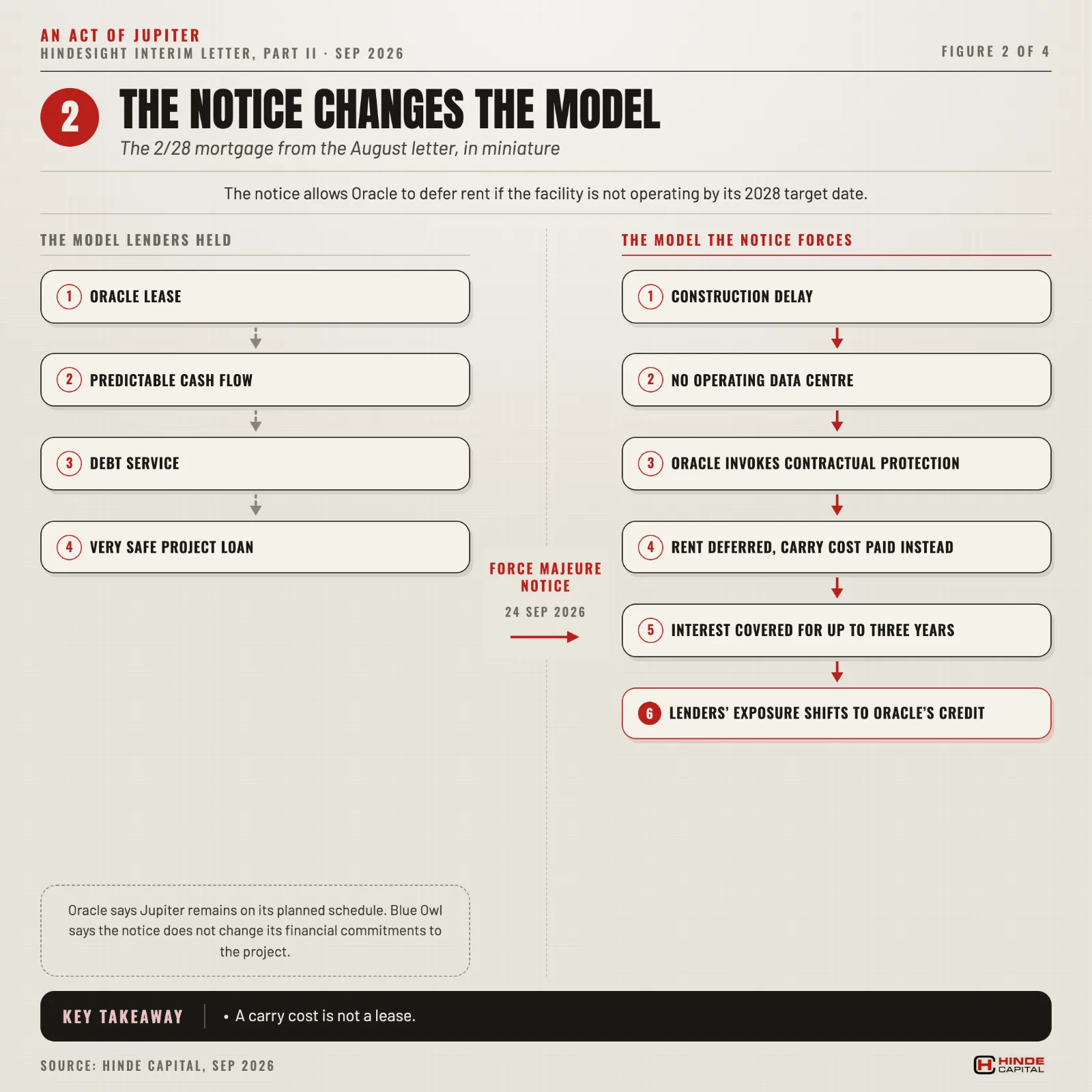
This is the 2/28 mortgage from the August letter in miniature, a structure that performs beautifully through the build and steps up to full obligation on a date fixed at signing. Jupiter adds a twist the mortgage lacked. The tenant can move the reset date.
The lenders are better protected than the notice first suggested. The Financial Times reported later the same day that Oracle remains liable for a carry cost in lieu of rent for up to three years if the first phase is not ready in the first half of 2027, covering interest to debt holders in full and some return on equity for Blue Owl.10 Debt service does not stop. What changes is what the loan rests on. While the carry cost runs, lenders are exposed to Oracle's BBB- credit rather than to an operating data centre, and that protection lapses after three years. A carry cost is not a lease. That is why a loan whose interest is covered in full can still trade at 90.
Growth and Stress in the Same Quarter
Oracle's own numbers show why revenue growth and financing stress are not opposites. Fiscal first-quarter revenue rose 30 per cent to $19.3 billion, cloud infrastructure revenue rose 121 per cent, and RPO reached roughly $664 billion. In the same quarter capital expenditure reached $28.5 billion, free cash flow was negative $5.4 billion against negative $362 million a year earlier, and Oracle completed a $20 billion at-the-market equity raise.11 S&P had already cut the company to BBB-, one notch above high yield, in July.7
This is the earnings question from the August letter in its cleanest form yet. The business is accelerating and the credit market is flinching, in the same quarter, over the same company. Both are true.
How the quarter was funded matters as much as its size. Operating cash flow reached $23.1 billion, but a new line within it, customer prepayments with a significant financing component, supplied $11.4 billion, close to half.12 Most of the more than $30 billion of new AI contracts signed in the quarter were structured as prepayments or bring-your-own-hardware deals that, Oracle says, need no additional capital from it. Oracle's co-chief executive, Clay Magouyrk, was precise about what that means. The capital expenditure still happens. It is simply not Oracle's cash that funds it. He prefaced the distinction on the earnings call with a disclaimer.13
"So, you know, at the... I'm not an accountant, but I get to play one on TV sometimes."
Without the prepayments, the quarter's free cash flow would have been nearer negative $17 billion than negative $5 billion. The financing risk has not left the chain. It has moved one step down, to customers who, in Magouyrk's own example, may have raised the money to pay in advance.
“So, you know, at the... I’m not an accountant, but I get to play one on TV sometimes.Clay Magouyrk, Co-Chief Executive, Oracle · Earnings Call, 10 September 2026
Beyond Oracle
The Financial Times reported on 20 September that Big Tech is carrying roughly $300 billion of AI-related exposure off balance sheet through residual-value guarantees and SPVs, against a sector-wide commitment figure Morgan Stanley puts above $3 trillion.14 Alphabet's data-centre guarantees rose from $16.9 billion to $43.8 billion in six months, with less than 2 per cent of that recognised as a balance-sheet liability. Broadcom has backstopped a customer's lease payments up to about $29 billion, a commitment its management linked to Anthropic's capacity,15˒16 Meta carries roughly $28 billion tied to its Hyperion facility, and Nvidia roughly $105 billion tied to SB Energy.14 The August letter described the boundaries between supplier, customer, investor, financier and guarantor growing less distinct. These are the numbers attached to that blurring, and they reach well beyond Oracle.
They also disguise how concentrated the demand is. SB Energy's Ohio campus leads back to OpenAI. So does Jupiter, through Oracle. So does much of SoftBank's AI exposure. The system looks diversified by corporate name and is far more concentrated in economic substance. On the map in Part I, all three lines run back to the same terminus.
The same few companies also sit on several sides of the same deals. Nvidia invests in an AI company, the AI company buys Nvidia GPUs, and the data centre housing them is financed partly against contracts with that same AI company. None of this is improper. While capital flows and asset values hold, the loop reinforces itself exactly as the Soros section of the August letter described. When funding tightens, it runs the same way in reverse.
What Has Not Happened Yet
The right test of whether Jupiter is systemic is whether a second or third project loan trades at a similar discount, and that test has not been met. Reporting still treats the 89 to 91 cent quote as an open question, and several accounts frame the next Stargate site financing as the test of whether it is a Jupiter idiosyncrasy or the market's new comparable for AI infrastructure debt.4 Until a second project loan trades at a similar discount, Jupiter is better read as a hold-up at one station than as a fault on the line.
The longer chain by which this stress could reach equity valuations remains mostly theoretical.
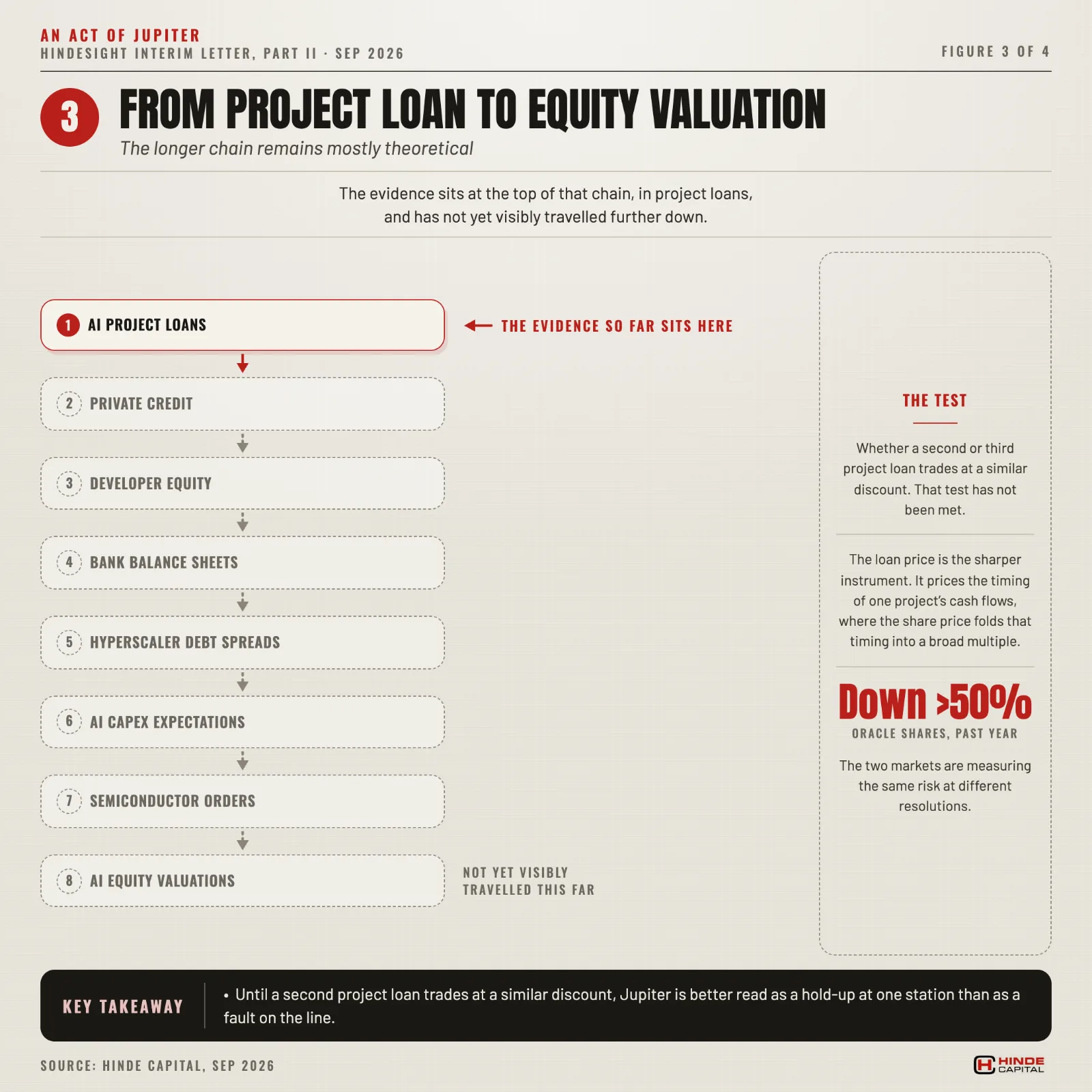
The evidence sits at the top of that chain, in project loans, and has not yet visibly travelled further down.
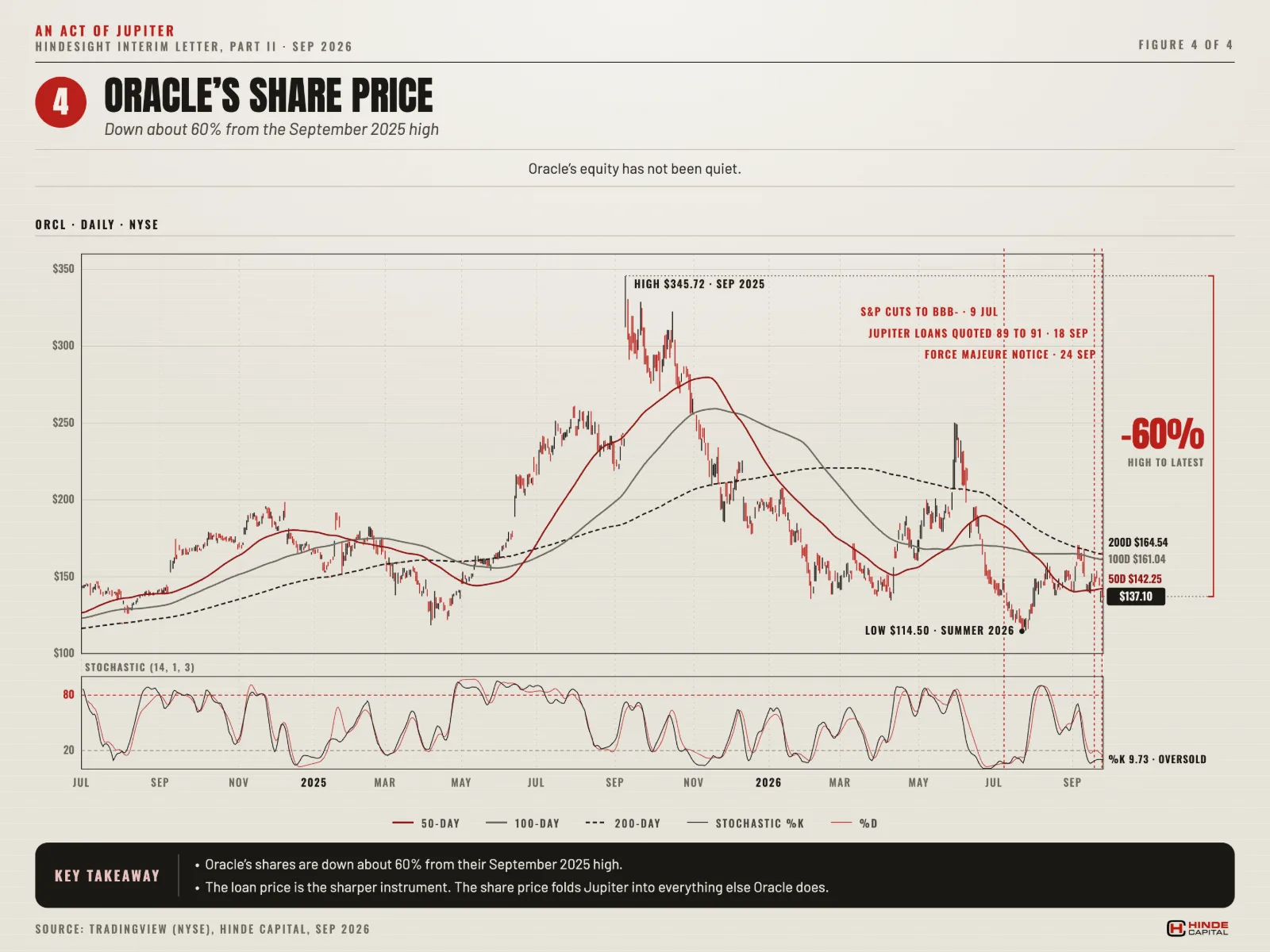
Nor is it quite right to say credit caught this before equities did. Oracle's equity has not been quiet. The shares are down about 60 per cent from their September 2025 high and fell on both reports.17 What is true is that the loan price is the sharper instrument. It prices the timing of one project's cash flows, where the share price folds that timing into a broad multiple. The two markets are not disagreeing. They are measuring the same risk at different resolutions, and the loan market has the finer lens.
Where This Leaves the Thesis
Jupiter does not prove the thesis. One project at 90 cents is a single migration in progress. It is, however, the first case where every element the August letter described has appeared in one place with a date on it. There is a take-or-pay structure that steps up on a fixed schedule, a physical bottleneck arriving ahead of the financial one, SPV debt resting on a single-name lease, and a credit market pricing that dependency more precisely than the equity market.
Two things would weaken it. The next Stargate-linked financing could price at or near par, or Jupiter's own loans could recover towards par once the pipeline and air permits clear. Either would suggest the discount belongs to one delayed site. If instead the next financing opens at a discount from day one, the market has started pricing the asset class rather than the project, and that is the signal worth waiting for.
Jupiter will almost certainly be built. The question the August letter posed in The Size of the Prize was whether being right about AI demand makes the timing irrelevant. At Jupiter the answer is already quoted, at 90 cents. A tenant can plead an act of God.
There is no force majeure clause for the credit cycle.
Part III follows tomorrow, on where the AI credit complex now stands against the 2007 sequence.
Sources
- 1Bloomberg, “Oracle Cites ‘Force Majeure’ to Shield Itself on Controversial Data Center,” 24 September 2026.
- 2Financial Times, report on Project Jupiter loans quoted at 89 to 91 cents on the dollar, 18 September 2026, as relayed by Reuters.
- 3Reuters Breakingviews, “Oracle freakout exposes fragile data center boom,” 25 September 2026, which puts the bank loans at roughly $20 billion, with Goldman Sachs among the lenders. The difference from the FT's $18 billion may reflect facility size against amounts drawn or arranged.
- 4Reuters, “Analysis-Oracle, Blue Owl project delay sends ripples through AI financing, sources say,” 24 September 2026.
- 5TIKR, “Oracle's Project Jupiter Loans Are Trading at 90 Cents. Here's What the Q1 Numbers Say,” citing the Financial Times and Reuters, September 2026.
- 6Ben Davies, HindeSight, “A Credit Cycle Wearing AI's Costume,” August 2026, citing Stijn Van Nieuwerburgh, Columbia Business School.
- 7S&P Global Ratings, Oracle downgrade to BBB-, 9 July 2026.
- 8Oracle and Blue Owl statements on Project Jupiter, via Yahoo Finance and 24/7 Wall St., 24 September 2026.
- 9Santa Fe New Mexican, local reporting on Project Jupiter permitting, September 2026; Sift & Signal, “Oracle hit force majeure on its biggest AI site. The loans were already at 89 cents,” September 2026.
- 10Financial Times, “Oracle on the hook to pay data centre investors even if site has no electricity,” 24 September 2026.
- 11Oracle Investor Relations, fiscal 2027 first-quarter results, September 2026.
- 12Oracle Corporation, Form 10-Q for the quarter ended 31 August 2026, filed 11 September 2026, condensed consolidated statement of cash flows (increase in deferred revenues from customer prepayments with significant financing component, $11,363 million) and note on significant financing components.
- 13Oracle Corporation, fiscal 2027 first-quarter earnings call, 10 September 2026, remarks by Clay Magouyrk, co-chief executive, and Hilary Maxson, chief financial officer; transcripts via Benzinga and AlphaStreet.
- 14Financial Times, Big Tech off-balance-sheet AI exposure through residual-value guarantees and SPVs, 20 September 2026, including the Morgan Stanley sector commitment estimate.
- 15Broadcom Inc., Form 10-Q for the quarter ended 2 August 2026, Note 10, Financial Guarantee, and contractual commitments; Form 10-K for the fiscal year ended 2 November 2025.
- 16Broadcom Inc., fiscal 2026 third-quarter earnings call, 4 September 2026.
- 17TradingView, Oracle Corporation (NYSE: ORCL), daily prices to 25 September 2026; high of $345.72 in September 2025, close of $137.10.
This is not investment advice. It is one person thinking out loud about markets, usually with a position on, so assume I may be talking my own book. That is not a confession, merely useful information. Views can change quickly, occasionally before the ink is dry, and I am not going to defend a trade simply because I once wrote about it with great conviction. Nothing here is an offer, solicitation or recommendation to buy or sell anything.
I write HindeSight primarily for me. The process forces me to test the thesis, join a few dots, throw some away and, with luck, understand the problem rather better than when I started. If it sparks a thought in someone else, even better. There is no publication schedule. I write when I have something to say or when the urge becomes sufficiently annoying that writing it down is easier. I can be tactically bearish and medium-term bullish, long one week and short the next. Markets rarely reward consistency for consistency’s sake. My objective is simpler: find the best risk/reward and try to extract as much upside as possible while giving as little back as possible.
Hinde Capital no longer manages external capital, so there is nothing to sell you. Past performance is no guide to future returns and, frankly, neither is this letter. Do your own work, size risk so you can still sleep, and seek regulated advice where appropriate. No liability is accepted for losses arising from reliance on this material, including those incurred after forwarding it to your sister- or brother-in-law. © Hinde Capital 2026.