Signal Failure
In 1933 Harry Beck, an engineering draughtsman, redrew the map of the London Underground. He abandoned true distances and geography and kept only what a passenger needed, which lines run through which stations and where they meet. A credit system under strain can be drawn the same way. What matters is less the size of each node than the lines that connect it to the others, because those are the routes along which a delay in one place becomes congestion everywhere else. The AI build-out is such a system, a network of tenants, borrowers, lenders and guarantors in which trouble at one point travels down the lines to the rest.
The HindeSight Investor Letter of August 2026, entitled A Credit Cycle Wearing AI's Costume, set out the thesis behind this series. Hyman Minsky observed that stability breeds instability. A long run of success makes lenders and borrowers comfortable with more risk, and financing migrates in three stages. In hedge finance, an investment's own cash flows cover both interest and principal. In speculative finance, they cover the interest but the principal has to be refinanced. In Ponzi finance, the structure survives only on rising asset prices or fresh capital. No single step looks reckless, because each is a sensible response to the last one working. The August letter's thesis was that AI can succeed as a technology while the financing built around it makes exactly this migration, through take-or-pay contracts, off-balance-sheet leases and project debt written against revenue that does not yet exist.
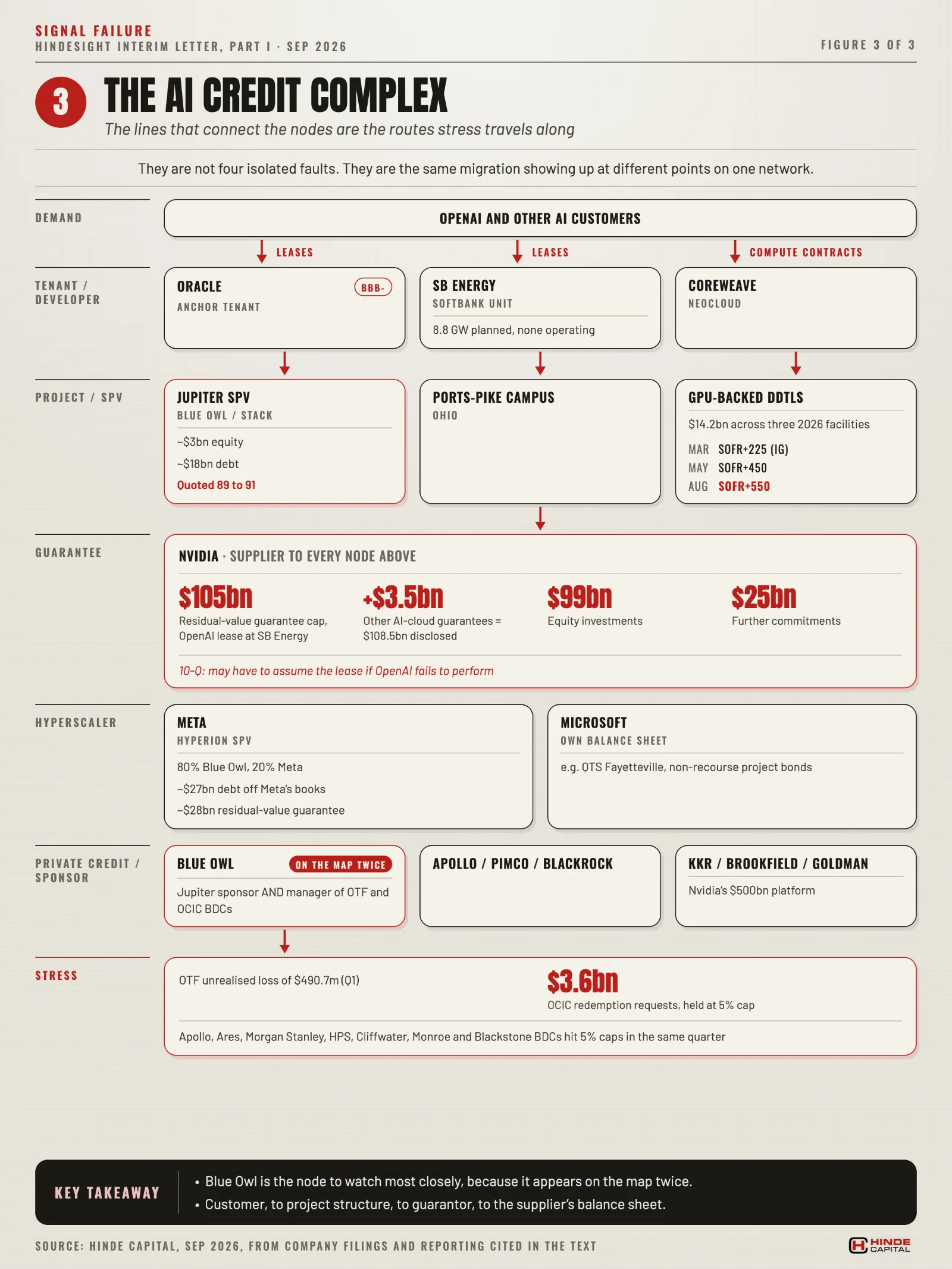
In September that Minsky migration began to show up on the network, like signal failures on the Underground. A train held at a single station is an inconvenience. A hold-up at an interchange, where several lines meet, as the District and Victoria lines do at Victoria, spreads delays across the system. There were four such signals this month. Oracle's Jupiter loans were quoted at 90 cents, CoreWeave paid steadily more to borrow against its chips, SB Energy's stock market listing stalled, and redemption requests queued up at Blue Owl's credit funds. They sit at different points on the network, the project, the neocloud, the developer and its guarantor, and the private-credit sponsor, and several of them share a line. They are not four isolated faults. They are the same migration showing up at different points on one network.
This first part of the series draws that network, so that a signal at any node can be read against where it sits rather than in isolation. Part II follows the first station to light up, Project Jupiter, the Oracle-anchored data-centre campus in New Mexico whose $18 billion of loans are quoted at around 90 cents. Part III asks how far along Minsky's sequence the system has travelled.
The Size of the Stack
Morgan Stanley and the Wall Street Journal have each put a number on the whole. Morgan Stanley counts about $3 trillion of off-balance-sheet commitments to AI infrastructure across seven companies, the five largest hyperscalers plus Nvidia and Broadcom, on top of about $770 billion of debt and lease obligations already on their balance sheets.1˒2 The Journal's count of nine companies also reaches about $3 trillion, growing faster than capital expenditure of about $600 billion over the past year.3
I wanted to check that those totals held up, so I went back to the filings. The five hyperscalers in Morgan Stanley's count, Microsoft, Meta, Alphabet, Amazon and Oracle, show about $1.2 trillion of leases signed but not yet commenced and about $1.5 trillion of purchase commitments in their latest reports, some $2.7 trillion in all, which matches Morgan Stanley's figure for the same five.2 A purchase commitment is a signed, largely non-cancellable obligation to take and pay for equipment, capacity or services that has not yet reached the balance sheet, the hyperscaler’s version of a take-or-pay contract for chips and build-out.4 The printed figure is a floor, since orders that can be cancelled without penalty are left out, and not all of it is AI. Alphabet’s total, for instance, includes content licences and energy contracts running to 2054.5 The other two in its count are chipmakers. Nvidia's filing adds $279 billion of supply commitments, its own obligations to suppliers such as TSMC and the memory makers, and $108.5 billion of guarantees,6 and Broadcom's $126.8 billion of purchase commitments and a backstop of up to $29 billion on a customer's lease payments.7 Together these are consistent with Morgan Stanley's total of more than $3.1 trillion.
Size is where most commentary stops, and the filings show why it is the wrong place to stop. Microsoft's annual report lists $329.1 billion of leases, primarily for data centres, signed but not yet commenced.8 Meta's filing shows $278.99 billion, plus about $68 billion more signed in July, alongside $349.31 billion of non-cancellable contractual commitments.9 Alphabet's purchase commitments reached $811.0 billion at the end of June, up from $332.4 billion three months earlier.5 Oracle's latest quarterly filing shows $288 billion of uncommenced leases, Amazon's $137 billion and Alphabet's $85.2 billion.5˒10˒11 Fifteen months earlier, Oracle's figure was $43.4 billion.10 Figure 1 sets these out by tier, from the hyperscalers at the top to the insurers and pension funds at the bottom.
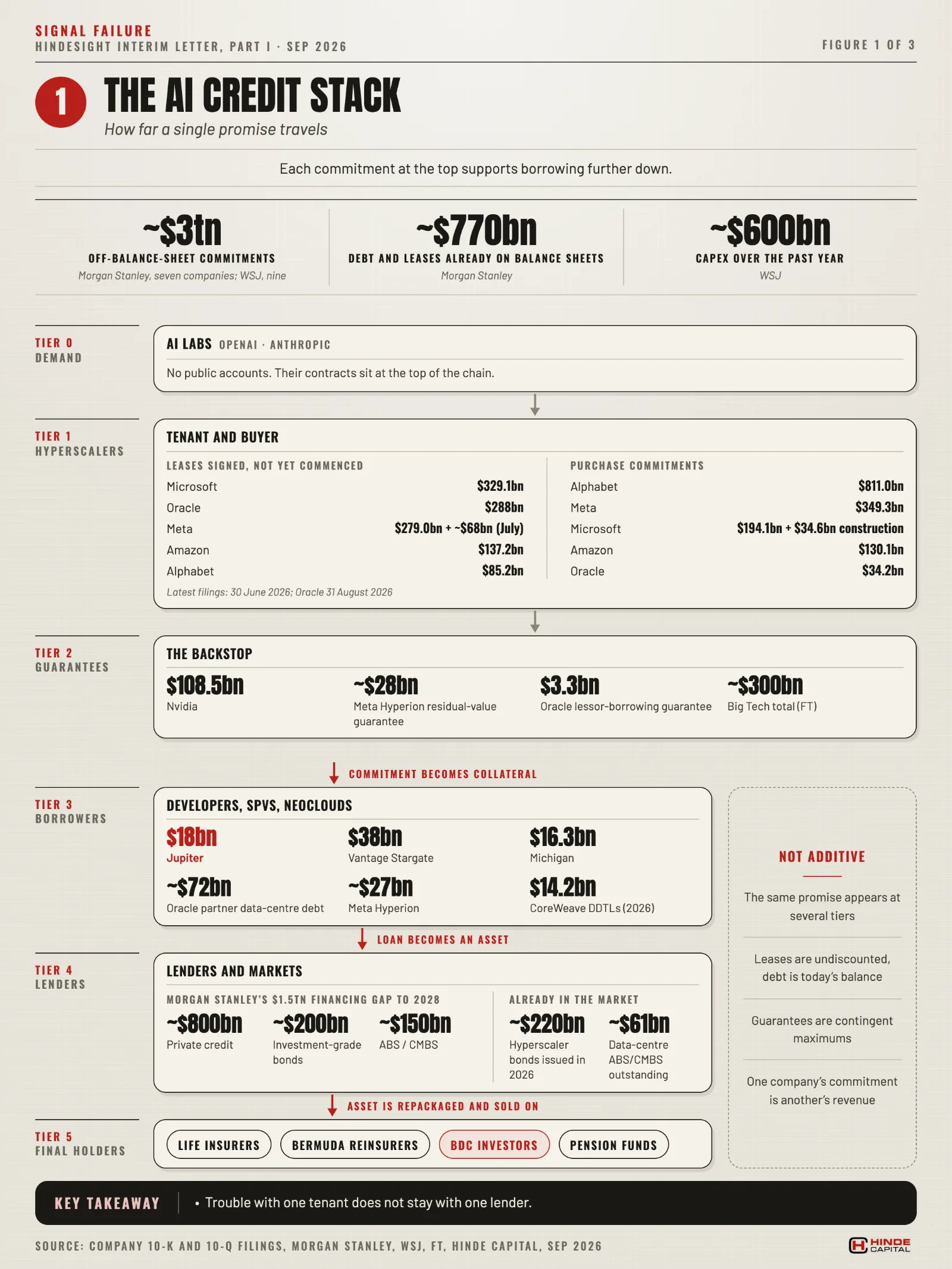
Four reasons stop the tiers being added together, and together they are the strongest part of the case. The stack is not just large. It is layered.
The same promise appears more than once. A hyperscaler's lease commitment is what a developer borrows against. That loan is an asset for a bank or private credit fund, and it may then be packaged into a security bought by an insurer. At Jupiter, Oracle's lease sits within its $288 billion of commitments, supports the $18 billion loan to the project vehicle, and now sits on the syndicate banks' books. One obligation appears three times. Meta's Hyperion campus appears both as about $27 billion of development costs and as a guarantee threshold of about $28 billion.9
The layers are measured differently. Lease commitments are undiscounted payments stretching up to 30 years, and in present-value terms they are materially smaller. Debt is a balance owed today. Purchase commitments are orders for chips and equipment rather than borrowing, though they are fixed obligations.
Guarantees are contingent. They are maximum exposures that bite only if a tenant fails and its space cannot be re-let or sold. Nvidia's phases in only from fiscal 2029, and only after a default.6 Counting the full cap overstates the likely loss. Counting nothing understates the risk.
One company's commitment is another's revenue. The hyperscalers' purchase commitments are Nvidia's and the memory makers' future sales, and Oracle's leases are paid for out of its contracts with customers such as OpenAI. A total that adds both sides counts the same transaction as an obligation and as income.
The $3 trillion is therefore a fair figure for one tier, the hyperscalers' own commitments. The error would be stacking the borrowing further down the chain on top of it. What the stack shows instead is how far a single promise travels. Morgan Stanley's own description is the clearest: suppliers and data-centre developers can borrow against the hyperscalers' leases, guarantees and purchase commitments, so capacity is built before the hyperscalers pay anything or recognise a liability.1 Each commitment at the top supports borrowing further down, which is why trouble with one tenant does not stay with one lender.
The Map
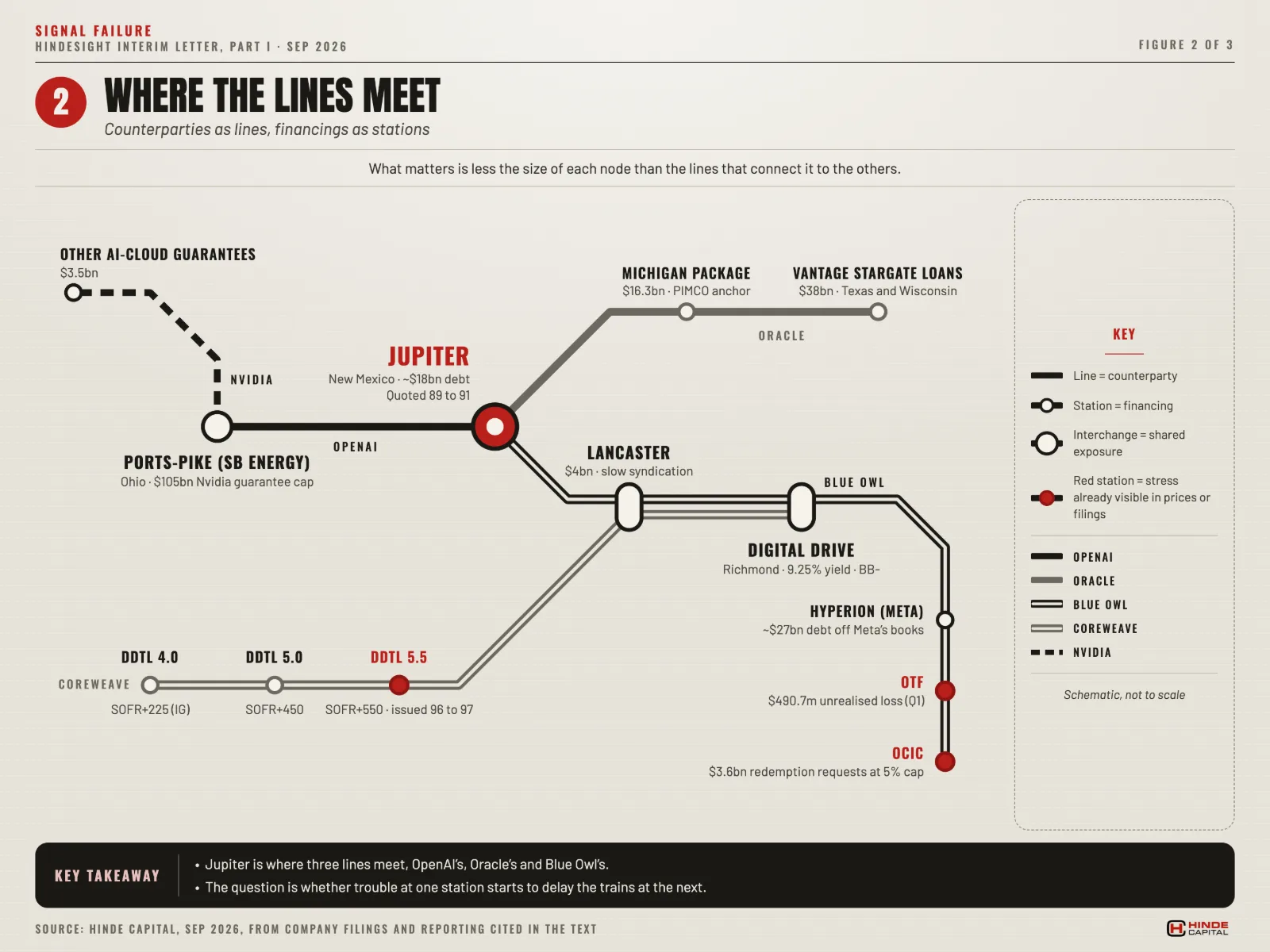
Figure 2 zooms into one corner of that stack, the network around Oracle, OpenAI, Blue Owl, CoreWeave and Nvidia. It is not the whole complex. It is the part where the lines cross most often and where stress has already reached prices, while the investment-grade core above it still borrows at will.
Where the Four September Signals Sit
Read against the map, each of September's four signals is a fault at a different point on the network. Taken in turn, they run from a project that is late, to a borrower whose financing keeps getting dearer, to a developer whose guarantor is a chipmaker, and finally to the one station where two lines already meet.
Jupiter's 89 to 91 cent loan sits in the project layer, priced against Oracle's lease. It is the take-or-pay bridge from the August letter, a fixed obligation arriving on a date indifferent to whether the projection behind it was right, and Part II covers it in full.
The pricing. CoreWeave's debt backed by graphics processing units (GPUs) sits one line over, and it is a different mechanism. Jupiter's risk is a delay in construction and permits, a problem of timing. CoreWeave's is the value of the collateral and the quality of the customers behind it. The evidence is a pricing sequence across three delayed-draw term loans, or DDTLs, which CoreWeave draws in stages to buy GPUs, secured against the chips and the customer contracts they serve. In March the $8.5 billion DDTL 4.0 priced at the Secured Overnight Financing Rate (SOFR), the benchmark US floating rate, plus 225 basis points, rated A3 and A(low) against an investment-grade customer, the first time this asset class had cleared that bar. In May the $3.1 billion DDTL 5.0 priced at SOFR plus 450, rated Ba2 and BB+, against non-investment-grade customer contracts. In August the $2.6 billion DDTL 5.5 priced at SOFR plus 550, against a broader and shorter-dated set of contracts, with the same Ba2 and BB+ ratings as May's facility.12 The same class of collateral has been repriced by 325 basis points in five months, because lenders are pricing the counterparty and the tenor behind each facility more finely than a rating on the asset class ever could.
The maturity gap. DDTL 5.5's own disclosure to the Securities and Exchange Commission (SEC) is the cleanest primary-source example of the Minsky migration anywhere on the map. The facility runs about five years against customer contracts averaging only about three, and CoreWeave states plainly that lenders are therefore underwriting renewal and re-leasing risk, not just the cash flows of contracts already signed.12 That is the shift from hedge towards speculative finance in Minsky's own terms. For the final two years of the loan, repayment depends on CoreWeave renewing or replacing tenants on terms nobody can yet observe.
Who stands behind it. The facility was also offered at a discount, at an issue price of 96 to 97 cents according to a term sheet seen by the Financial Times, and people familiar with the syndication told the FT that Anthropic accounted for about 40 per cent of the underlying contracts and Jane Street about 35 per cent, with Midjourney, Hudson River Trading and Anysphere making up the rest.13 CoreWeave itself has not named the counterparties. Jane Street is also a CoreWeave shareholder, after a $1 billion strategic investment disclosed with the company's second-quarter results, which puts it on two sides of the same structure, as customer and investor.14
Where the rate risk lands. The spread is only half the cost. It is fixed at signing, but the SOFR beneath it floats. DDTL 4.0 and 5.0 accrue at daily compounded SOFR and DDTL 5.5 at Term SOFR, reset each interest period, so any rise in short rates passes into CoreWeave's interest bill.12 The lenders are largely protected, since a floating-rate loan holds its price when rates rise. The risk lands on the borrower instead. CoreWeave's customer contracts pay agreed prices while its financing costs move with the market, and its own quarterly filing, the 10-Q, puts the effect of a 100 basis point rise at about $61 million of extra interest over six months on its floating-rate debt at 30 June.15 It has swapped some of that exposure to fixed, and DDTL 4.0 includes a fixed-rate tranche, but the unhedged remainder moves with the rate path. DDTL 4.0, for one, carries a debt service coverage covenant, which is where such a squeeze would register.12 This is the Minsky mechanism at the level of a single borrower, debt service growing harder without anything having gone wrong in the business.
The guarantee. SB Energy sits higher, at the top of the demand layer, and its signal arrives a step earlier than either Jupiter's or CoreWeave's. Public equity is declining to fund a developer before a single facility of its 8.8 gigawatts is operating, and in the same weeks Holtec paused and Aggreko slowed their own listings.16 Nvidia sits directly underneath. Its 10-Q for the quarter ended 26 July discloses a conditional cap of $105 billion on residual-value guarantees supporting OpenAI's lease at SB Energy's PORTS-Pike campus in Ohio.6
In Nvidia's own words. That filing is worth reading in the original, because Nvidia's own risk disclosure states the August thesis more plainly than any commentary could. If OpenAI fails to perform or becomes insolvent, Nvidia says it may have to assume the lease itself, find a replacement tenant or pursue a sale, and could end up making substantial payments if no replacement tenant or buyer can be found on acceptable terms.6 Customer, to project structure, to guarantor, to the supplier's balance sheet. The August letter described that transmission mechanism, and a chip company has now written it into an SEC filing.
The wider book. The same 10-Q discloses a further $3.5 billion of land, power and shell guarantees for other AI cloud partners, taking total disclosed guarantees to $108.5 billion, alongside $99 billion of equity investments and $25 billion of further equity commitments across the ecosystem.6 None of this is a cash liability today. The guarantees are conditional and phase in only as the Ohio campus comes online from fiscal 2029. It is nonetheless $108.5 billion of Nvidia's credit standing now underwriting the customers it sells to.
A possible replacement tenant. Nvidia's agreement on 2 September to buy Hugging Face, the largest platform for open AI models, adds a further turn.17 Huang has spoken of connecting the infrastructure Nvidia supports to offtake demand from its developer ecosystem.18 If the OpenAI lease at PORTS-Pike ever needed a replacement tenant, Nvidia would now own a candidate. That would not remove the risk. It would move it onto Nvidia's own books, with guarantor and tenant becoming the same company, and a platform whose own models are built to run on little compute is a long way from filling a campus built for OpenAI.
A second chipmaker. Nvidia is not the only chipmaker underwriting its customers. Broadcom's latest quarterly filing shows purchase commitments of $126.8 billion, up from $132 million last November, and a backstop on a customer's lease payments with a maximum exposure of about $29 billion,7 which management linked on its earnings call to Anthropic's capacity.19 The same customer may issue Broadcom up to $42 billion of convertible notes if needed, which would make the supplier a lender to its own buyer.7
Blue Owl is the station to watch most closely, because two lines already meet there. It is the equity sponsor and developer inside Jupiter. It also manages two business development companies (BDCs), the funds through which private credit lends to mid-sized companies. Blue Owl Technology Finance Corp (OTF) and Blue Owl Credit Income Corp (OCIC) are showing some of the clearest private-credit stress in the sector, $490.7 million of unrealised losses at OTF in the first quarter20 and $3.6 billion of redemption requests at OCIC held at the 5 per cent cap.21 Nothing establishes a causal link between the two. The BDC markdowns are not confirmed to be AI-related, and Blue Owl's wider book is diversified private credit rather than data-centre debt. Blue Owl attributed the marks to spread widening and has said it will reduce the fund's software exposure.22 Nor is Blue Owl alone. Non-traded BDCs managed by Apollo, Ares, Morgan Stanley, HPS, Cliffwater, Monroe and Blackstone all received redemption requests above 5 per cent of shares in the second quarter and held repurchases at the cap.21 But the August letter's observation that the boundaries between supplier, customer, investor, financier and guarantor are blurring applies here more literally than anywhere else on the map. The same manager is sponsoring the project whose loans trade at 90 and absorbing markdowns and redemption requests in its credit funds, in the same season.
One further signal is an absence. Much of the risk sits with private counterparties, OpenAI and Anthropic among them, in contracts Oracle does not name, and no instrument lets an investor hedge those names directly. The market's liquid substitute has been Oracle's credit default swaps (CDS), which a run of commentary this summer treated as a proxy for AI-infrastructure leverage rather than for Oracle alone.23 Dealers have since built sector products. JPMorgan has offered a five-name hyperscaler CDS basket since February,24 and in July added baskets of investment-grade hyperscaler and project bonds and of AI high-yield issuers.25 Those products average the cohort. They do not name OpenAI or Anthropic, and they have not displaced single-name Oracle CDS as the place where concentrated hedge flow sits.
The slices that are public are large enough on their own. The Wall Street Journal reported a roughly $300 billion, five-year OpenAI computing contract with Oracle beginning in 2027, a figure Oracle has not confirmed in its filings,26 against $664 billion of remaining performance obligations at 31 August.27 What nobody publishes is the customer-level total, and the credit market has the same blind spot. Investors who cannot hedge the private names buy the nearest liquid proxy, hedging flow concentrates in one name, and that name's CDS can move for reasons that are only partly its own.
What Filings Show, and What Only Prices Can
Two kinds of evidence sit on this map, and they carry different weight. The first is structural, what a company has filed about the size, terms and risk of a financing. The second is a market price, what the debt or its derivative actually trades at today. The Nvidia guarantees above, and the Oracle detail below, are the first kind, taken from primary filings rather than press coverage. They establish that the financing architecture is evolving as the August letter described. They cannot establish that any of the debt is mispriced or moving towards default, which only a market price can show.
Oracle's own term sheet of 4 February shows the $25 billion raised that day split across eight tranches, from $0.5 billion of floating-rate notes due 2029 to $2.75 billion of 6.85 per cent notes due 2066, within a stated plan to raise $45 to $50 billion during 2026 in roughly equal parts debt and equity.28 Two tranches matter most, the 4.95 per cent notes due 2031 and the 5.70 per cent notes due 2036, because they bracket the maturities where July's downgrade to BBB- should show most clearly in secondary pricing. The filing gives the size and the coupon. Where that paper trades now is the missing piece, and the one to watch into the next rating decision.
Across the Whole Network
Step back from the individual stations and the same migration shows up across the credit markets as a whole. Two measures capture it, where AI borrowing is being done and how willing investors are to fund it.
The Bank of England's July Financial Stability Report put a number on how quickly AI financing has moved to the riskier end of the market. AI-related issuers accounted for 41 per cent of non-refinancing US high-yield issuance so far this year, against roughly 1 per cent of the JPMorgan high-yield index at the end of 2025.29 Private credit shows the same shift from the other side. AI accounted for 34 per cent of private-credit deal value in 2025, up from 9 per cent in 2024,30 and the Financial Stability Board put AI at more than a third of private-credit deals last year, against 17 per cent over the previous five years.31 On the map, that is the sponsor layer, Blue Owl, Apollo, KKR and the rest, turning from diversified lenders into books increasingly concentrated in one theme within a single year. That is the pace at which the Minsky section of the August letter says underwriting migrates, rather than one bad decision being made.
The bond market points the same way. Apollo's tracking shows cover ratios on hyperscaler bonds, investor orders relative to bonds issued, falling from nearly five times in February to below two times in July. The chart alongside shows the average cover ratio across all investment-grade bonds holding broadly flat over the same months.32 On 28 July, 78 of the 91 hyperscaler bonds issued in 2026 with comparable pricing data were trading at higher yields than at issuance, by a median of about 22 basis points.33 By September Reuters was describing an investment-grade market split in two, with AI-linked issuers facing caution and wider concessions while traditional issuers enjoy strong bidding, and with hyperscaler gross issuance projected at $420 billion for 2027, up 60 per cent on 2026.34 None of this says a name will default. It says what CoreWeave's three facilities say at the level of a single issuer. Credit is pricing this asset class with more discrimination than it was six months ago.
The discrimination is showing up as cost, not as closure.
The Four Assumptions Holding It Up
Every node on the map depends in the end on one of four assumptions holding. Naming them gives a cleaner way to read new signals than treating each headline as a fresh and unrelated event.
The first is that demand for AI compute stays enormous. Nothing in this series questions it, and it is the one assumption a broad AI slowdown would attack directly rather than through any single financing structure.
The second is that the customers behind these structures can actually honour multi-year compute commitments. Jupiter and SB Energy both bear on this, since both rest on OpenAI-linked leases whose value depends on OpenAI's ability to pay every counterparty at once, a total nobody discloses in one place.
The third is that GPUs and data centres keep enough residual value to support the debt written against them. CoreWeave's repricing is the cleanest test of this available. The $300 billion of residual-value guarantees the Financial Times reported are the system's insurance against this assumption failing, which makes them transferred tail risk rather than a solved problem.35
A mismatch of lives. A data centre's shell, power connection and cooling last for decades, while the chips inside turn over every few years. Meta depreciates its buildings over 25 to 30 years and its servers and network equipment over five to five and a half.36 The debt against a campus is written against the long-lived layer and the lease, but the lease is only worth what the tenant can earn from the short-lived layer, so a single project loan now spans several generations of chips. Oracle has flagged the same exposure in its own position. Its data-centre leases generally run 15 to 19 years, and it has warned that their duration, renewal terms and pricing may not align with its customer contracts, leaving it exposed if customers do not renew or cannot perform.37
Microsoft's change of estimate. Microsoft has just shown how much turns on these estimates. From the start of its 2027 fiscal year it is extending the estimated useful life of its data centres and office buildings from 15 to 25 years. Its finance chief said the change barely touches operating income and that the greater impact is on capital expenditure, because more future data-centre leases will be classed as operating rather than finance leases, and only finance leases count as capex. Microsoft now expects calendar 2026 capex of about $175 billion rather than $190 billion, with its investment plans otherwise unchanged.38
The accounting rule behind it. The mechanism is in the lease rules. A lease that runs for the major part of an asset's economic life, conventionally 75 per cent or more of it, is treated as a purchase and recorded as a finance lease.39 Microsoft's 10-K shows a weighted-average remaining term of 13 years on its finance leases, against six years on operating leases, and notes that some leases can be terminated within a year.8 On the 75 per cent test, a 13-year lease stays an operating lease only if the building is assumed to last more than 17 years, and a 20-year lease, the longest in its signed pipeline, would need 27. Credit for spotting this goes to Michael Burry, whose analysis of the hyperscalers' filings I read while checking this work.40
Why now. What sits behind the change explains its timing. Microsoft had $329.1 billion of leases, primarily for data centres, signed but not yet commenced at the end of June, due to start between fiscal 2027 and 2033, against $88.5 billion of lease liabilities already recognised.8 More than $130 billion of that was signed in the June quarter alone.41 These are the uncommenced leases the August letter described, commitments that have not yet become conventional liabilities. The same company that now assumes its buildings last a quarter of a century describes the chips and servers inside them as short-lived assets.38 The August letter noted that accounting conventions can reinforce this cycle without any fraud at all. This is a new example.
The fourth is that capital markets stay open long enough for each generation of infrastructure to refinance the one before it. The cover-ratio data and the Bank of England's report both speak to this directly. Markets have not closed, but the margin for error has visibly narrowed this year. That is precisely the condition in which a genuinely idiosyncratic shock, a second Jupiter or a sharper CoreWeave repricing, stops being idiosyncratic and starts testing the whole structure at once.
What the Map Does and Does Not Show
It does not show a completed chain of contagion. The systemic test, which Part II sets out, is a second project loan pricing at a discount similar to Jupiter's, and it has not been met. What it does show is that the four September signals are not four unrelated problems that happen to share a news cycle. They sit at four different points on the network, the project, the neocloud collateral, demand and its guarantor, and the private-credit sponsor. Three of the four, Jupiter, SB Energy and Blue Owl, share at least one counterparty.
The map is a snapshot, and one large node sits outside it.
The borrower. SpaceX absorbed xAI in February, listed in June and within weeks carried investment-grade ratings from Moody's, S&P and Fitch and $25 billion of new bonds, refinancing the debt behind Musk's purchase of Twitter and xAI's own borrowing.42˒43 In the first quarter it spent $7.7 billion on AI infrastructure, and the AI business lost $2.5 billion.44
The tenants. Its data centres show the same features seen elsewhere on the map. Anthropic has taken Colossus 1 capacity in Memphis at $1.25 billion a month, Google has agreed to pay $920 million a month for Colossus capacity from October, and Reflection AI $150 million a month. Each contract can be ended on 90 days' notice, Google's after December and Reflection's after its first three months, against infrastructure financed for years.45˒46
The power bottleneck. The Environmental Protection Agency has said turbines used as primary power need air-quality permits, and xAI ran a fleet of methane turbines at its Memphis complex without them, the same kind of power problem that stalled Jupiter.47
A second terminus. Anthropic, already behind much of CoreWeave's latest facility and Broadcom's lease backstop, is Colossus's anchor tenant, which makes it a second terminus alongside OpenAI.13˒19 That is a line for the next letter.
The thing to watch is not any single node repeating. It is stress appearing at two layers at once, for instance a second project loan discount in the same month as a BDC markdown tied specifically to data-centre exposure rather than to diversified credit. That combination would be the first real test of whether these are idiosyncratic events or the reflexive system of the August letter beginning to run in reverse. If the coming months bring isolated signals that stay on their own lines, the map will have overstated the connections.
Beck's map works because a passenger rarely needs to know how far apart two stations are, only whether they share a line. Jupiter is where three lines meet, OpenAI's, Oracle's and Blue Owl's. The question now is whether trouble at one station starts to delay the trains at the next.
Part II follows tomorrow, on Project Jupiter, the first station on the map to light up.
Sources
- 1Morgan Stanley research on hyperscaler off-balance-sheet commitments, as reported in the Axios Markets newsletter, “Trillions of dollars,” August 2026.
- 2Bloomberg Law, “AI-Related Off-Balance-Sheet Commitments Top $3 Trillion: MS,” 25 August 2026, reporting Morgan Stanley research led by Todd Castagno.
- 3Peter Rudegeair and Peter Santilli, “Why Big Tech’s AI Spending Is $3 Trillion Higher Than It Seems,” The Wall Street Journal, August 2026.
- 4Financial Accounting Standards Board, Accounting Standards Codification 440, Commitments, disclosure of unconditional purchase obligations (ASC 440-10-50).
- 5Alphabet Inc., Form 10-Q for the quarter ended 30 June 2026, filed 23 July 2026.
- 6NVIDIA Corporation, Form 10-Q for the quarter ended 26 July 2026.
- 7Broadcom Inc., Form 10-Q for the quarter ended 2 August 2026, Note 10, Financial Guarantee, and contractual commitments; Form 10-K for the fiscal year ended 2 November 2025.
- 8Microsoft Corporation, Form 10-K for the fiscal year ended 30 June 2026, filed 29 July 2026, Note 13, Leases (weighted-average remaining lease terms, lease liabilities and leases not yet commenced).
- 9Meta Platforms, Inc., Form 10-Q for the quarter ended 30 June 2026, filed 30 July 2026.
- 10Oracle Corporation, Form 10-Q for the quarter ended 31 August 2026, Note 6, additional lease commitments; Oracle Form 10-K for the fiscal year ended 31 May 2025.
- 11Amazon.com, Inc., Form 10-Q for the quarter ended 30 June 2026, filed 31 July 2026, Note 4, Commitments and Contingencies.
- 12CoreWeave, Inc., SEC Form 8-K filings and accompanying releases for DDTL 4.0 (30 March 2026), DDTL 5.0 (15 May 2026) and DDTL 5.5 (7 August 2026), including interest-rate terms, ratings and covenants.
- 13Financial Times, “CoreWeave bows to investor pushback on debt linked to Anthropic contracts,” 30 July 2026. Issue price from a term sheet seen by the FT; counterparty split from people familiar with the matter, not company disclosure.
- 14CoreWeave, Inc., “CoreWeave Reports Strong Second Quarter 2026 Results,” 11 August 2026.
- 15CoreWeave, Inc., Form 10-Q for the quarter ended 30 June 2026, Item 3, Quantitative and Qualitative Disclosures About Market Risk.
- 16New York Times-sourced reporting, “SoftBank-Backed SB Energy Delays IPO As Investors Push Back On $50B+ Valuation,” 21 September 2026, including Holtec and Aggreko.
- 17NVIDIA Corporation, Form 8-K, 2 September 2026, definitive agreement to acquire Hugging Face, Inc., expected to close in the first half of 2027 subject to regulatory approvals.
- 18Yahoo Finance, “Nvidia confirms $13 billion acquisition of open-weight AI platform Hugging Face,” 3 September 2026.
- 19Broadcom Inc., fiscal 2026 third-quarter earnings call, 4 September 2026.
- 20Blue Owl Technology Finance Corp., Form 10-Q for the quarter ended 31 March 2026, net change in unrealised loss on investments of $490.7 million.
- 21SEC EDGAR, Blue Owl Credit Income Corp (OCIC) Form 8-K and 10-Q, 2026; Reuters via Investing.com and Yahoo Finance, “Blue Owl keeps 5% redemption caps as OCIC requests ease from prior quarter,” 2 July 2026, citing S&P Global Market Intelligence and PitchBook data.
- 22Reuters, “Blue Owl will reduce private credit exposure to software,” 7 May 2026.
- 23Financial Times, report on credit default swaps as a broader market proxy for bearish bets on technology names, 27 July 2026.
- 24Bloomberg, “JPMorgan Offers Clients a New CDS Basket to Hedge AI Debt Risk,” 23 March 2026.
- 25Caleb Mutua, “Goldman Offers Way to Trade AI Junk Bonds $250 Million at a Time,” Bloomberg, 23 July 2026, which also reports JPMorgan's three cash baskets launched that week.
- 26The Wall Street Journal, report on OpenAI's roughly $300 billion, five-year computing contract with Oracle, September 2025.
- 27Oracle Corporation, Form 10-Q for the quarter ended 31 August 2026, filed 11 September 2026, remaining performance obligations.
- 28Oracle Corporation, pricing term sheet for $25 billion of senior notes, 4 February 2026.
- 29Bank of England, Financial Stability Report, July 2026.
- 30Themes ETFs, market data on AI share of private-credit deal value, April 2026.
- 31Financial Stability Board, assessment of AI share of private-credit deals, as reported by The Guardian, 6 May 2026.
- 32Torsten Sløk, Apollo Daily Spark, “Cover Ratios for Hyperscaler Bonds Declining,” 15 July 2026, text and accompanying chart, Bloomberg data.
- 33Patturaja Murugaboopathy, Reuters, “Hyperscaler debt binge pushes yields up as investor demand cools,” 29 July 2026, LSEG data.
- 34Reuters, “Corporate bond buyers get picky with flood of AI debt,” 22 September 2026.
- 35Financial Times, Big Tech off-balance-sheet AI exposure through residual-value guarantees and SPVs, 20 September 2026.
- 36Meta Platforms, Inc., Form 10-K for the year ended 31 December 2025, estimated useful lives of property and equipment.
- 37Reuters analysis of hyperscaler uncommenced data-centre leases, via Virginia Business, “Big Tech commits $1 trillion to AI data centre leases,” 2026.
- 38Microsoft Corporation, fiscal 2026 fourth-quarter earnings call, 29 July 2026, remarks by Amy Hood, chief financial officer; CFO Dive, “Microsoft holds line on AI spending plans,” July 2026.
- 39Financial Accounting Standards Board, Accounting Standards Codification 842, Leases, implementation guidance at 842-10-55-2 on the major part of remaining economic life.
- 40Michael Burry, “Capital Cycle IQ & Forensic Files on the Big 5 Hyperscalers,” The Heretic’s Guide to AI’s Stars Part V, Cassandra Unchained, 24 September 2026.
- 41Bloomberg Law, “Microsoft Reports Over $130 Billion in New Data Center Leases,” 29 July 2026.
- 42IFR, report on SpaceX's debut investment-grade ratings (Moody's Baa1, Fitch BBB+, S&P BBB, stable outlooks), 26 June 2026.
- 43Bloomberg, SpaceX's $25 billion five-tranche investment-grade bond sale refinancing its March bridge loan, 23 June 2026.
- 44SpaceX first-quarter 2026 segment results from its registration statement, as reported by the Motley Fool, 9 July 2026, and Forbes.
- 45SpaceX, Form S-1 registration statement, May 2026, and amendment of 5 June 2026, on the Anthropic and Google compute agreements; Barron's and TechCrunch coverage, June 2026.
- 46Reuters, TechCrunch and Data Center Dynamics, 22 June 2026, on SpaceX's compute agreement with Reflection AI.
- 47US Environmental Protection Agency, interpretation on turbines used as primary power at a fixed site, January 2026; NAACP and Earthjustice Clean Air Act complaint against xAI, April 2026.
This is not investment advice. It is one person thinking out loud about markets, usually with a position on, so assume I may be talking my own book. That is not a confession, merely useful information. Views can change quickly, occasionally before the ink is dry, and I am not going to defend a trade simply because I once wrote about it with great conviction. Nothing here is an offer, solicitation or recommendation to buy or sell anything.
I write HindeSight primarily for me. The process forces me to test the thesis, join a few dots, throw some away and, with luck, understand the problem rather better than when I started. If it sparks a thought in someone else, even better. There is no publication schedule. I write when I have something to say or when the urge becomes sufficiently annoying that writing it down is easier. I can be tactically bearish and medium-term bullish, long one week and short the next. Markets rarely reward consistency for consistency’s sake. My objective is simpler: find the best risk/reward and try to extract as much upside as possible while giving as little back as possible.
Hinde Capital no longer manages external capital, so there is nothing to sell you. Past performance is no guide to future returns and, frankly, neither is this letter. Do your own work, size risk so you can still sleep, and seek regulated advice where appropriate. No liability is accepted for losses arising from reliance on this material, including those incurred after forwarding it to your sister- or brother-in-law. © Hinde Capital 2026.